When it comes to Google Ads for B2B, we often hear the following sentence: „We tested Google Ads once. Didn't work, just burned money.“
Regardless of whether we hear this from the management or employees in marketing: They are usually right. Because their campaigns have burned money.
But not because Google Ads doesn't work in B2B. It's because the strategy was wrong. Someone once set up a campaign, hoped that it would work and then said „It doesn't work“.
Yet the opportunity is so great: A buyer types „CNC milled parts contract manufacturing“ into Google. He has a specific need. Now, not someday.
Such search queries happen every day, in every niche, even with search volumes of 50 or 100 per month.
Anyone who is visible at this moment with a suitable ad and a proper landing page will receive a qualified inquiry. If you are not visible, you will lose the contact to the competitor who has done better.
The problem is rarely the channel. B2B Google ads simply have different rules than ads for B2C.
Smaller target groups, higher click prices, decision-making processes that take weeks and months. Sales cycles of around 100 days are normal. If you don't take this into account, you will be disappointed after four weeks. Those who take it into account will build up a predictable channel for new customer inquiries.
In this „Google Ads for B2B“ guide, we'll go through everything you need to know. From the Keyword research from the campaign structure to the specific ROI calculation. Also for cases in which you would be better off investing the budget elsewhere.
B2B vs. B2C: What's different and why it's important
Before we talk about keywords and bidding strategies, we should take a look at the special features of B2B marketing. Because these influence our further decisions in the campaign strategy.
Let's start with the obvious: Purchase decisions in B2B take weeks to months.
In B2C, someone clicks on an ad, puts the product in the shopping cart, done. (Ok, that's a bit exaggerated. But the fuse is much shorter here).
In the B2B environment, the issues are more complex. First a buyer researches, sends their inquiry to three suppliers, discusses the options with the technical manager, then submits a recommendation to the managing director, and at some point approval is given.
On average, it takes 31 touchpoints for a B2B deal to materialize. Your first ad is one of them. No more, no less.
What's more, 6 to 7 people are typically involved in a B2B purchase decision.
The buyer who does the research. The technical manager who checks the specifications. The management who approves the budget. Sometimes the quality assurance department.
Your ad must arouse the curiosity of the first contact, but the landing page must also provide material for the other parties involved: Data sheets, references, white papers, technical details.
What makes it attractive in B2B nonetheless is that the value of a single new customer is enormous. If an order brings in 50,000 or 80,000 euros, 8 euros per click is no reason to panic. The calculation still works as long as you get the right people to your site.
And the target group? Tiny. A manufacturer of rotary transfer machines has perhaps 500 potential customers worldwide. The search volume is 50 to 200 inquiries per month. That would be a problem for an online store. For B2B, it's an advantage because almost every single searcher is relevant.
| Factor | B2C | B2B |
| Sales Cycle | Minutes to days | Weeks to months |
| Decision maker | 1 person | 3-7 persons (Buying Committee) |
| Search volume | High (1,000+/month) | Low (50-500/month) |
| Click prices (CPC) | 0,50-3 € | 3-40 € |
| Conversion target | Purchase, shopping cart | Lead, Request, Download |
| Landing page | Product page, Shop | Whitepaper, contact form, demo |
Keyword strategy: Where the budget goes (or is wasted)
The keyword selection determines what you pay for. This is where the most expensive mistakes are made. And the easiest profits are made.
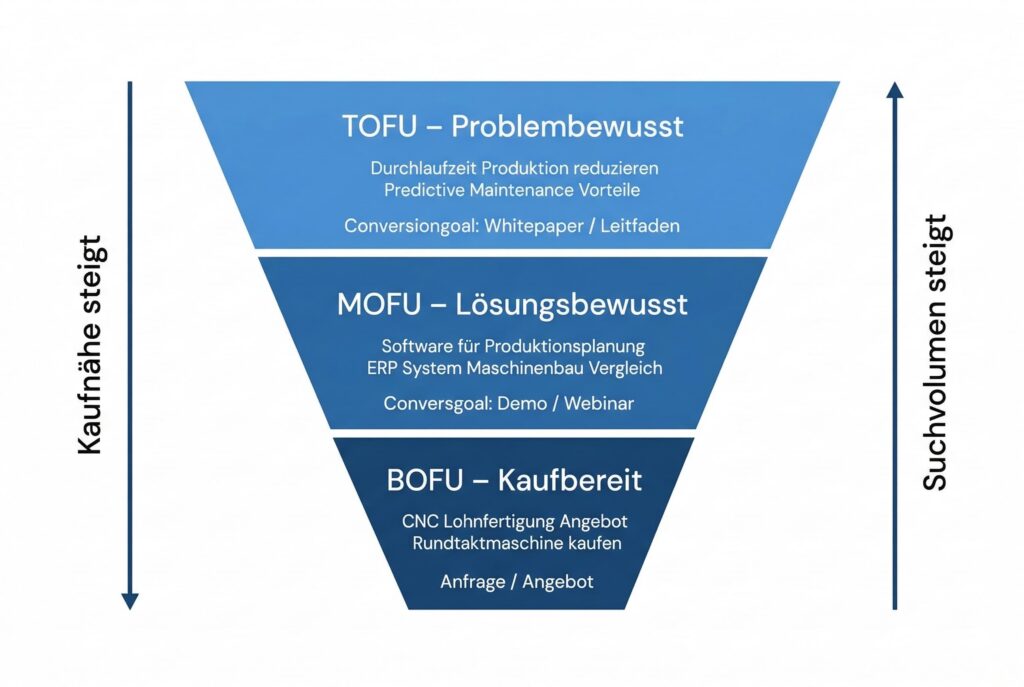
Sort keywords in the funnel by purchase proximity
We like to work with funnels in marketing. This is also useful when selecting keywords for Google Ads. Because not every search term is the same distance away from a possible deal. The division into three stages helps to use the budget in a targeted manner.
Purchase-related keywords (bottom of funnel) are the ones you should start with. Someone is actively looking for a supplier or a product. Examples from industry: „carbide manufacturer Germany“, „CNC contract manufacturing offer“, „buy rotary transfer machine“, „industrial cleaning service provider Munich“. People who search like this don't want to be informed. They want to buy.
Evaluation keywords (middle of funnel) come from people who know their problem and compare solutions. „Software for production planning“, „Automation assembly consulting“, „ERP system mechanical engineering comparison“. The conversion rate is slightly lower, but the leads are in an active decision-making phase.
Information keywords (top of funnel) such as „Reduce production throughput time“ or „ISO 9001 Audit prepare“ rarely generate direct inquiries. However, they can be useful if you offer a lead magnet, such as a white paper or a guide.
Our recommendation: Start with keywords close to purchase (BoFu). If you achieve stable results there and still have budget left over, work your way up the funnel.
Negative keywords: More important than most people think
In B2B, the list with List of keywords to be excluded (so-called negative keywords) are often more valuable than the actual keyword list. The reason: Many B2B search terms overlap with B2C, job searches or purely informational queries. If you advertise a „3D printer“ as a mechanical engineering company, you will get clicks from people from the DIY environment. That costs money and doesn't achieve anything.
So we add the keyword „3d drucker industrie“ and at the same time explicitly exclude [3d drucker]
Typical negative keywords for industrial companies:
- Job-related: „job offer“, „salary“, „training“, „internship“, „career“, „jobs“
- B2C filters: „private“, „hobby“, „used“, „ebay“, „amazon“, „build it yourself“, „DIY“
- Informational: „Wikipedia“, „definition“, „what is“, „referat“
- Price range filter: „cheap“, „inexpensive“, „free“, „free“
Tip for regular checks: Check the search term report (in Google Ads under Statistics → Search terms) at least once a week. Ideally daily in the first few weeks. Every irrelevant click that you exclude here early on saves you money.
Keyword options: Better to start narrow in the B2B environment
Keyword options in Google Ads control how closely a search query must match your keyword in order to trigger an ad.
Google distinguishes between three main types: Largely suitable („Broad match“, maximum range), Matching word group („Phrase Match“, medium volume) and Just right („Exact Match“, highest relevance/precision)
Our recommendation: Start with Phrase Match or Exact Match. Broad Match can work later on, but it produces too much noise at the beginning.
- Exact Match [keyword]: Maximum control, limited range. Good for the beginning. Expand later if range is limited.
- Phrase Match „keyword“: Good compromise, but can sometimes lead to irrelevant clicks.
- Broad match keyword: Only recommended with a strong negative keyword list and smart bidding on a conversion basis.
Ad texts in B2B: Attract and repel at the same time
The texts of your ads have a dual role. They should persuade decision-makers to click. And they should also prevent irrelevant target groups such as private individuals, students or job seekers from clicking.
You can achieve this, for example, by including the use case in the title of the ad. Be as specific as possible.
Instead of „3D printer“, we write „3D printer for industrial production“. Instead of „cleaning service“, we write „industrial cleaning for production facilities“.
Deliberately include these so-called filter terms. Words such as „for companies“, „industrial solution“, „B2B“ or „large quantities“ in the ad ensure that private individuals don't even want to click.
They know immediately: I'm in the wrong place. This avoids irrelevant clicks. The more precise the wording, the lower the scatter loss.
Also, always address the problem of your target group. What is the buyer or production manager currently concerned about? Delivery delays? Quality problems? Rising material costs? What is he afraid of? Production standstill? Competition passing by? Put that in the headline.
B2B decision-makers respond to figures. „98.7 % delivery reliability“, „On the market since 1987“, „Over 2,000 systems worldwide“, „ISO 9001 certified“. These are not empty phrases, they are arguments.
One point that is often forgotten with ads is the ad extensions. Particularly valuable in B2B. Sitelinks to references and industry solutions, callout extensions with „Made in Germany“ or „24-hour service“, a call extension (B2B decision-makers are more likely to pick up the phone than B2C customers) and structured snippets with product categories or industries.
They also ensure that your Quality Score (ad quality) on Google Ads increases.
Practical example: Advertisement for a manufacturer of industrial gearboxes
Headline 1: Industrial gearboxes - Made in Germany
Headline 2: For heavy-duty applications | Individually manufactured
Headline 3: Request answered in 24 hours
Description 1: High-precision industrial gearboxes for mechanical engineering, conveyor technology and mining. In-house design, manufacture and assembly. Request data sheet now.
Description 2: Over 1,500 gearboxes per year. Delivery time from 6 weeks. Personal advice from our engineers. Arrange a free initial consultation.
Campaign structure: Our tried and tested setup for B2B
The campaign structure is like the outline of your Google Ads account. Here's a setup that has worked well for B2B companies:
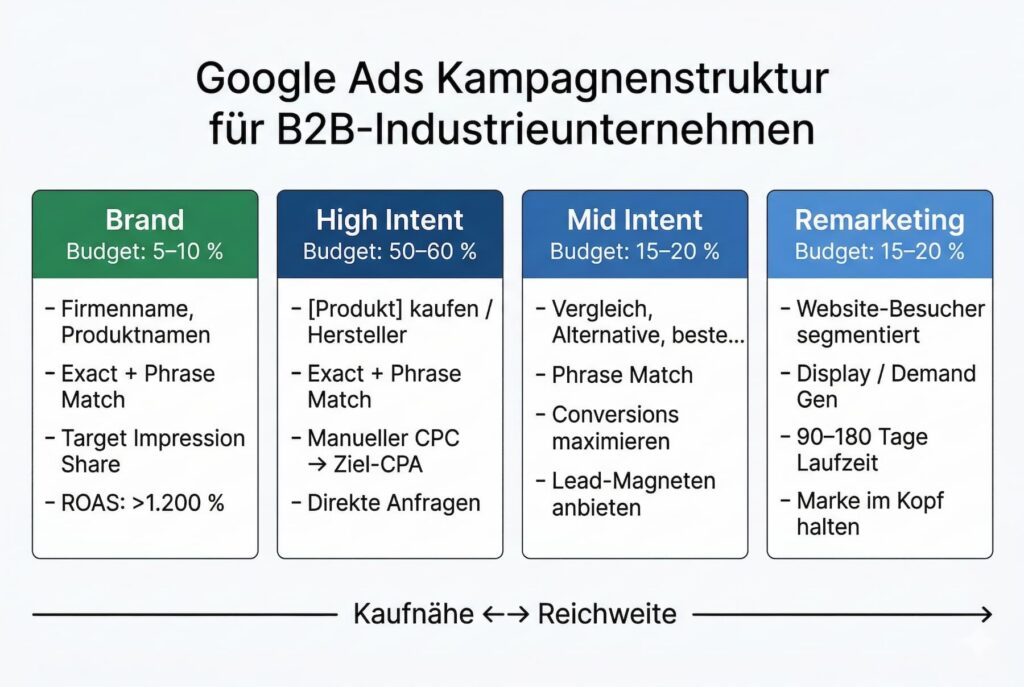
Campaign 1 - Brand (brand protection). Keywords: your company name, product names, brand names. Exact and phrase match. This prevents competitors from targeting your brand name with ads. The click prices are low, the ROAS extremely high. According to the Dreamdata B2B Benchmarks, brand campaigns achieve an ROAS of over 1,200 %. Bidding strategy: Target impression share.
Campaign 2 - High Intent (buy close). Keywords such as „[product] buy“, „[product] manufacturer“, „[service] offer“. Exact and phrase match. This is where the main budget goes in, because this is where the people are who actually want to make an inquiry. Bidding strategy: Manual CPC at the start, later target CPA when enough data is available.
Campaign 3 - Mid Intent (evaluation). Keywords: „[product category] comparison“, „best [solution] for [industry]“, „[competitor] alternative“. Phrase match. These people are not as far along as those from campaign 2, but they are actively comparing. Good place for lead magnets.
Campaign 4 - Remarketing. Website-Visitors who have not converted. Best segmented: Who was on a product page? Who was on the contact page? Who viewed 3+ pages? Display or demand gen ads that keep your brand top of mind.
Budget distribution
As a rough guide to how you can distribute your budget across the 4 campaigns:
| Campaign | Budget share | Why |
| Fire | 5-10 % | Cheap clicks, high ROAS, brand protection |
| High Intent | 50-60 % | Highest probability of requests |
| Mid Intent | 15-20 % | Build a pipeline |
| Remarketing | 15-20 % | Accompanying long sales cycles |
Bidding strategies: Hands off „maximize clicks“
The Bidding strategy determines how much we pay for clicks, impressions or conversions in order to achieve our goals (e.g. more sales, higher visibility, whitepaper downloads). We can adjust bids either automatically via „smart bidding“ (AI-supported) or manually in order to optimize the budget for the campaign goals.
The „maximize clicks“ bidding strategy is usually not worthwhile, as this strategy is aimed at getting the cheapest possible clicks. It brings us traffic from people we don't want.
What works instead depends on the phase and your own goals:
In the first 1 to 3 months: Let the AI run. We collect data on which keywords lead to conversions and which do not.
From 15 to 30 conversions per month: Now we can switch to „maximize conversions“ or target CPA, for example. Google then has enough data points to optimize sensibly. We could still set a CPC limit so that the costs don't get out of hand.
From 50+ conversions per month: Those who return conversion values from the CRM (more on this later) can work with target ROAS. Google then optimizes for actual transaction value instead of simple form submissions.
One point that is often underestimated: Smart bidding needs data. With 10 leads a month, the algorithm is more likely to guess than to optimize. In many B2B niches, manual bidding therefore remains the better choice in the long term.
Often underestimated: the landing page
Often, even we as Google Ads Agency your hands are tied. Even the best ads are useless if the landing page does not convert.
You can do everything right with keywords, ads and bidding strategies. If the landing page doesn't fit, the money is still gone.
The worst-case scenario: All ads link to the homepage. A buyer searches for „sodium bicarbonate large containers“, clicks on the ad and lands on a page with a company history, mission statement and team photo. His search intention was not fulfilled. As a result, he goes back to Google and clicks on the next hit. We have spent money unnecessarily.
The solution: Each campaign should have its own landing page.
If someone searches for „CNC milled parts contract manufacturing“, the page must immediately show that you offer CNC milled parts in contract manufacturing. Materials, tolerances, delivery times, clear contact details. And no detour via the homepage.
What belongs on a B2B landing page
Immediately visible (above the fold): A headline that picks up on the keyword and the user's search intention. A subheadline with your strongest differentiating feature. Trust signals such as certifications, customer logos or „Since 1987". And a visible button or contact form.
Below that: Concrete service description without marketing-speak. References or anonymized case studies. Technical details and downloads. A short FAQ with the three most frequently asked questions from first-time prospective customers.
The following applies to the form: less is more. Name, e-mail, telephone, short message. Maybe company size or industry if that helps with qualification. But please don't use a 15-field form in which the telephone number is a mandatory field, the annual turnover is requested and the shoe size has to be entered. Every additional field costs you conversions.
Testing as the key to success
Not every campaign is successful. If only a single campaign is launched and there is no success afterwards, this does not automatically mean that Google Ads is not working.
We regularly see in our day-to-day agency work that individual campaigns don't work. But that's the great thing about performance marketing! I try something, then measure whether I'm successful or not and move on to the next round with the lessons learned.
The biggest mistake is to bury your head in the sand immediately after a failed attempt.
There are so many parameters that can determine the success or failure of a campaign:
- The choice of lead magnet fails to meet the needs of the target group
- The landing page is not high converting
- Contrary to internal assumptions, the topic is not relevant for the market
- The timing is wrong
- The ad message is too generic
- The user's search intention does not match the offer
- The keywords are too broad or too unspecific
- Competition is too strong in this area right now
- and much more.
The solution: A-B testing or even multivariate testing.
- Test landing pages against each other
- Try out different lead magnets
- Test several campaigns - not just one
- Test different ad texts against each other
- Test different headlines and descriptions
- Test several keyword sets in parallel
- Test different bidding strategies
- Try out different budget distributions
- and much more.
Conversion tracking: no result without measurement
It is extremely important that you track the success of your campaigns properly. You need clear KPIs. And - unpopular opinion - CPC is not a KPI. Instead, the KPIs should always be derived from your goals. And as described above: A cheap CPC usually only brings you cheap traffic that doesn't convert.
Separate macro and micro conversions
Your primary goals (macro conversions) could be: contact form submitted, call via telephone tracking (e.g. Matelso), quote requested, product purchased in the store, demo booked. These are the actions that you store as „primary conversion actions“ in Google Ads.
There are also signals that show interest, even if the visitor has not yet converted (micro-conversions): Whitepaper downloaded, product video watched halfway, 3+ pages visited in one session, newsletter signup. You classify these as „secondary“ so that they appear in the reports but don't confuse Smart Bidding.
30-day tracking window is not enough in B2B
By default, Google Ads tracks conversions within 30 days of the click. This is too short for B2B. Set the conversion window to 60 or 90 days. A surprisingly large proportion of leads only access the form weeks after the first click.
Restore RM data
If you want to do it right, connect your CRM (HubSpot, Salesforce, Pipedrive, whatever) with Google Ads. This allows you to import offline conversions, i.e. report them to Google: This lead who clicked on March 15 became a customer on June 10. This has two effects. You can calculate the actual ROAS, not the lead ROAS. And Google can optimize for real business value instead of form submissions.
Without a CRM connection, you optimize for leads. You don't know whether they lead to sales. With a CRM connection, you optimize for sales.
-
Benchmarks: What B2B Google Ads cost, in black and white
„What does it cost?“ is the first question every managing director asks. The answer depends on the industry and the competition, but orientation values can still help.
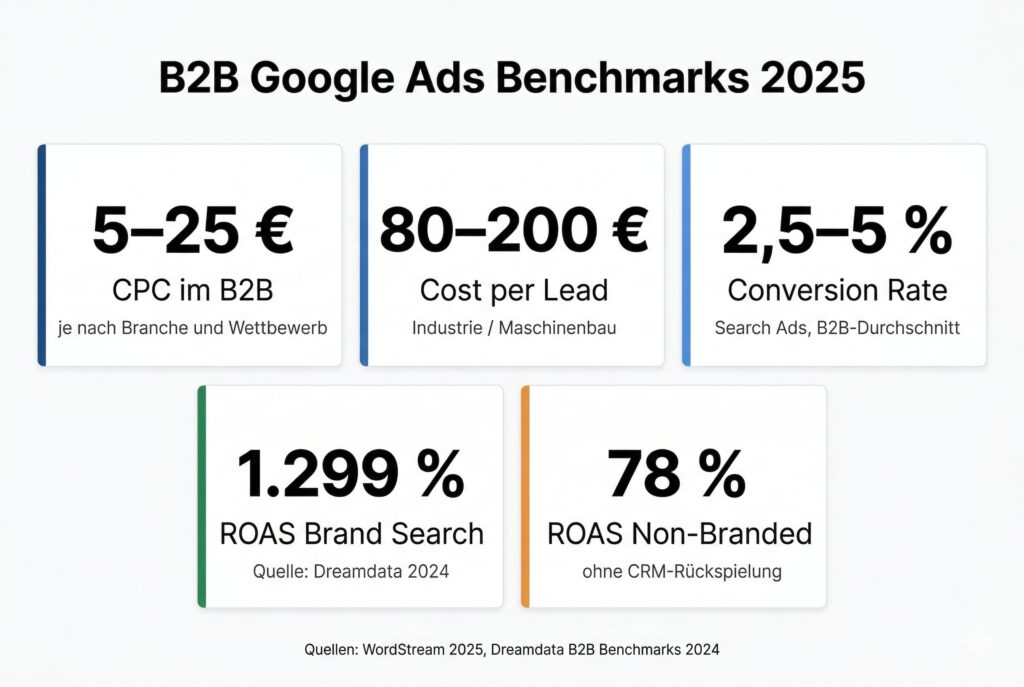
| Key figure | Cross-industry | B2B / Industry |
| Average CPC | 5.26 $ (approx. € 4.80) | 5-25 € (depending on niche) |
| Average CPL | 70 $ (approx. 65 €) | 80-200 € |
| Conversion rate (search) | 7,5 % | 2.5-5 % |
| ROAS Non-Branded Search | 78 % | Similar or lower |
| ROAS Brand Search | 1.299 % | Comparably high |
*Sources: WordStream 2025 Google Ads Benchmarks, Dreamdata B2B Google Ads Benchmarks 2024
Striking: Non-branded search ads in B2B have a ROAS of less than 100 %. Sounds unprofitable. But it often isn't, because B2B deals are closed months after the first click. What Google Ads shows as ROAS is only an excerpt. You can see the actual return in the CRM.
Calculated once: Determine your Google Ads budget
The most common question we get asked: What is a good ad budget? The answer we unfortunately always have to give is „It depends“. Above all, it depends on the goals and historical data. How good is your conversion rate? What is the CPC for the specific keyword? What are your goals? What is a conversion worth to you? What budget can you make available?
In the end, it's always the simplest math. An example calculation:
- Monthly budget Google Ads: € 3,000
- Average CPC: 8 €
- Clicks per month: 375
- Conversion rate: 3 %
- Leads per month: approx. 11
- Of these, customers become: 15 % (i.e. approx. 1.7 per month)
- Average profit per order: €50,000
- Monthly profit from Google Ads: approx. 85,000 €
- ROI: approx. 2,700 %
Even with a more pessimistic assumption - only 10 % lead-to-customer rate - 55,000 euros in sales land against a 3,000 euro advertising budget. Few leads, but high order values. The click prices, which would be ruinous in B2C, are well invested here.
8 mistakes we find in almost every B2B account
During our regular SEA audits of B2B Google Ads accounts, we come across the same optimization potential time and time again.
The start page as a landing page. This should be obvious, but we still see it frequently. Every campaign needs its own target page that matches the keyword.
No negative keywords. Then you pay for clicks from students, job seekers and hobbyists. A solid negative keywords list belongs in your account from day 1.
Keywords that are too broad. If you book „machine“ or „sensor“ as a keyword, you will get all kinds of results, but rarely the right one. Long-tail keywords with a clear search intention are mandatory in B2B.
There are also tracking problems: Without conversion tracking, you can't see what's working and what's not. You're shooting in the dark. Nevertheless, many companies launch campaigns without a single conversion goal.
Another classic is „Maximize clicks“ as a bidding strategy. Sounds good, but it optimizes for cheap clicks instead of good ones. An expensive mistake in B2B.
Then there are the accounts that are never touched again once they have been set up. Google Ads needs ongoing maintenance. Check search terms, adjust bids, test ads. Weekly, at least.
Search and display in one campaign is a mistake that Google itself encourages - it is the default setting. Nevertheless: Separate the campaigns. Search aims for conversions, display for awareness. Two goals, two campaigns, two budgets.
And the last point: the advertising time planner. Yours B2B target group searches on weekdays between 8 a.m. and 6 p.m. At weekends and in the evenings, it is mainly private individuals who click. If you don't set up the advertising time planner, you are paying for the wrong target group.
Remarketing recommended: 31 touchpoints need more than one ad
In B2B, enquiries are rarely made on the first visit. The research drags on, colleagues are involved, other providers are compared. Without remarketing, you lose prospective customers who actually had potential.
Segmentation by behavior: Lumping all website visitors into one remarketing pot works, but it's not particularly smart. Better: divide visitors according to their behavior on the site. Anyone who has visited a specific product page will receive product-specific ads. Anyone who was on the contact page but did not make an enquiry will receive a reminder. Anyone who has downloaded a white paper is shown further content.
Set the remarketing duration to 90 to 180 days. In B2B, a visitor who was on your site 60 days ago is far from being a cold contact.
Google Ads and trade fairs: A lever that hardly anyone uses
Industry trade fairs are still central to B2B sales. What few people do: Use Google Ads specifically around trade fairs.
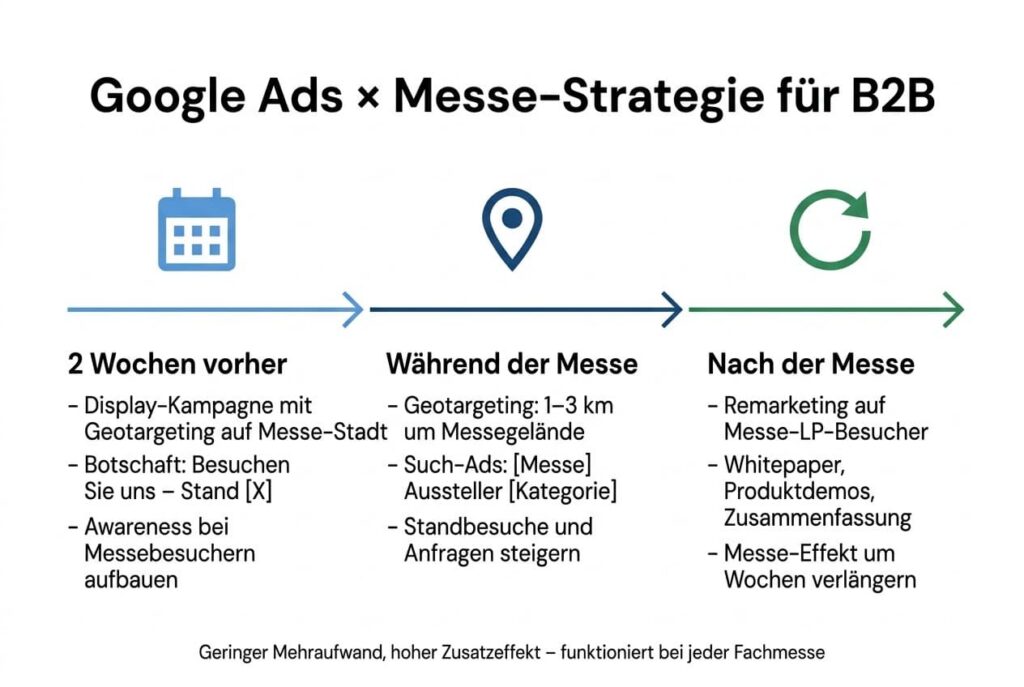
Two weeks before the trade fair: Display campaigns with geotargeting to the trade fair city. Message: „Visit us at the [trade fair], stand [X].“
During the trade fair: Geotargeting to a 1 to 3 kilometer radius around the trade fair grounds. In addition, search ads for keywords such as „[trade fair] exhibitor [product category]“.
After the trade fair: Remarketing to everyone who visited your trade fair landing page. Whitepaper, product demos, summary as follow-up.
This doesn't cost much extra, but extends the trade fair effect by weeks.
Channel comparison: Google Ads, LinkedIn Ads, SEO
Google Ads is not the only way to generate B2B leads. Sometimes another channel is the better choice. A sober comparison:
| Criterion | Google Ads | LinkedIn Ads | SEO |
| Principle | Intercepting demand (pull) | Generate demand (push) | Long-term visibility |
| Speed | Immediately (days) | Immediately (days) | Slowly (3-12 months) |
| Cost per lead | 80-200 € | 150-400 € | Low (after assembly) |
| Lead quality | High (active search) | Very high (targeting) | Mixed |
| Scalability | Limited (search volume) | High | High |
| Best for | Decision-makers close to purchasing | Awareness / Branding | Info content / Trust |
What works in practice: Start with Google Ads and take the demand close to the point of purchase with you. Add LinkedIn to build awareness among decision-makers who are not yet actively searching. Build up SEO in parallel for long-term organic traffic.
When it's better to invest your Google Ads budget elsewhere
Google Ads doesn't always fit. There are situations in which other channels are more effective.
The most obvious one: no one is searching for your product. If the search volume is close to zero because your offer is too new or too niche, there is no demand to intercept. LinkedIn, content marketing or trade fairs are a better way to generate demand.
The situation is similar with a website that is not ready. Slow loading times, no SSL, barely usable on a smartphone, no clear contact option. Every click falls flat, no matter how good the ad was. First get the website in order, then place ads.
You can't do it without conversion tracking. You don't know what works, you can't optimize anything. It would be like not measuring your time in a marathon - you run, but you don't know if you're getting better.
And finally: Sales must also process the leads. If an inquiry is in the mailbox for two weeks, the prospective customer has long since gone to the competitor. Google Ads delivers warm leads. But someone also has to answer the phone.
The first 90 days: what is realistic
Anyone starting Google Ads for the first time should know what happens when. Unrealistic expectations are one of the most common reasons why companies stop too early.
In the first month is all about data collection. The campaigns are running, you get your first clicks and collect search term data. You identify which keywords produce garbage and build up the negative keywords list. Maybe you get your first leads. Or maybe not. This month is for learning, not for earning.
Month two is all about optimization. Get rid of bad keywords, test ad texts, adapt landing pages. Lead quality increases, the cost per acquisition starts to fall. You get a feel for what works.
From Month three you can scale. Campaigns that work get more budget, remarketing is set up, mid-funnel keywords are added. Now you have a stable basis and real data on which you can make decisions.
After 90 days you will know whether Google Ads is worthwhile for your company. Based on figures, not assumptions.
Checklist: Are you ready for B2B Google Ads?
Before you start, go through these points:
☐ Are there at least 50 relevant searches per month for your core keywords?
☐ Do you have dedicated landing pages (or can you create them)?
☐ Is conversion tracking set up (Google Tag Manager, GA4, Google Ads)?
☐ Is the monthly budget at least €1,500-3,000?
☐ Can your sales team contact leads within 24 hours?
☐ Does someone regularly take care of the campaigns (5-10 hours per week, in-house or agency)?
☐ Do you have the patience to test for at least 3 months?
If you can tick off five or more points, the chances are good.
Conclusion
Google Ads is one of the most effective channels for B2B companies to acquire new customers. The channel reaches people who are actively looking for your solution at that moment. No trade fair visit or cold call can do that.
There is no autopilot scenario. You need a well-thought-out keyword strategy, separate landing pages for each campaign, clean tracking right through to sales and the willingness to give the channel 90 days before making a judgment.
The companies that achieve good results in B2B with Google Ads are not doing anything out of the ordinary. They do the basics consistently and adapt their campaigns on an ongoing basis. Sounds banal. But almost nobody does it.
Frequently asked questions about Google Ads in B2B
Is Google Ads worthwhile even with a very low search volume (less than 100 searches/month)?
Yes, if the order values are right. With an average order value of 50,000 euros, 2-3 qualified inquiries per month are enough to make the investment worthwhile. A low search volume is the norm in B2B, not an exclusion criterion. The decisive factor is whether the searchers are actually potential customers.
What is the minimum budget I need for B2B Google Ads?
We recommend at least 1,500 to 3,000 euros per month. Below 1,000 euros, there is no database for meaningful optimization. You need enough clicks to see which keywords and ads are working and which are not. With very high click prices (15-25 euros in some niches), a higher budget may be necessary to collect meaningful data.
How long does it take for Google Ads to deliver results in B2B?
The first leads can come in the first week. However, you need 3 months for a well-founded evaluation. In the first month you collect data, in the second you optimize, in the third you scale. If you give up after four weeks without spectacular results, you haven't given the channel a fair chance.
Does Google Ads work for B2B products that require explanation, such as special machines or custom-made products?
Google Ads is particularly strong for products that require explanation. Purchasers and technical managers search specifically for concrete solutions. Anyone googling „special machine for pipe processing“ has a specific problem. However, the landing page must then also deliver: technical details, references, data sheets, not just marketing platitudes.
Should I do Google Ads myself or hire an agency?
This depends on your internal resources. Google Ads requires at least 5-10 hours per week of ongoing support (checking search terms, adjusting bids, testing ads). If someone in-house has the time and interest to get involved, in-house can work. If you don't have this capacity, you are better off with a specialized B2B agency or an experienced freelancer. The mistake that many make: Handing the campaigns over to a working student and wondering why it's not working.
When should I use Performance Max instead of classic search campaigns?
Performance Max (PMax) can work in B2B, but requires caution. PMax mixes Search, Display, YouTube and Discovery in one campaign type. The problem: you lose transparency because you can no longer see which search queries lead to clicks. To get started, we recommend classic search campaigns because you have more control there. PMax is more worthwhile as a supplement from month 3-6, if you already have stable conversion data and can give Google enough signals.
How do I prevent private individuals from clicking on my B2B ads?
Three levers: Firstly, specific ad texts with terms such as „for companies“, „B2B“ or „industry solution“. Secondly, a clean negative keyword list that excludes terms such as „private“, „DIY“, „used“ or „ebay“. Thirdly, use the advertising scheduler and place ads primarily on weekdays between 8 am and 6 pm. It can never be completely prevented, but these three measures will noticeably reduce wastage.
Is it allowed to bid on the brand names of my competitors?
Yes, this is generally permitted according to an ECJ ruling. You may bid on your competitors„ brand names as keywords. What you are not allowed to do: use the protected brand name in the ad text. Instead, formulate with reference to your own strengths: “The alternative for [product category]„, “Made in Germany„, “GDPR-compliant". Competitor keywords often have higher CPCs (2-3x), but can bring good quality traffic because searchers are already in the comparison phase.
How do I measure the ROI of Google Ads if my sales cycle lasts 6 months?
This is only possible with a CRM connection. Connect your CRM (HubSpot, Salesforce, Pipedrive) with Google Ads and import offline conversions. This way you can tell Google that a click from March became a customer in September. Also extend the conversion window in Google Ads to 90 days (maximum). For deals that take even longer, you need a separate evaluation in the CRM in which you assign marketing touchpoints to sales.
Google Ads or LinkedIn Ads - what's better for B2B?
Both channels are justified, but solve different tasks. Google Ads captures existing demand: Someone is searching for your product, you are visible. LinkedIn generates demand: You reach decision-makers via job titles and industries, even if they are not currently searching. Google Ads usually has a lower cost per lead (80-200 € vs. 150-400 €), LinkedIn often delivers higher quality contacts. Most B2B companies that test both stick with a combination: Google for purchase-related traffic, LinkedIn for awareness and account-based marketing.
Do I need a separate landing page for each keyword?
Not for every single keyword, but for every campaign or keyword group with its own search intent. If you have „industrial gearbox manufacturer“ and „buy industrial gearbox“ in one campaign, one landing page is enough. For „gearbox repair“ you need a different one. The rule of thumb: If the searcher's expectations are different, they need a different page. If you direct all keywords to the start page, you are giving away money