Strategy workshop
Strategic clarity in 2 days.
(Instead of a 6-month project jungle)
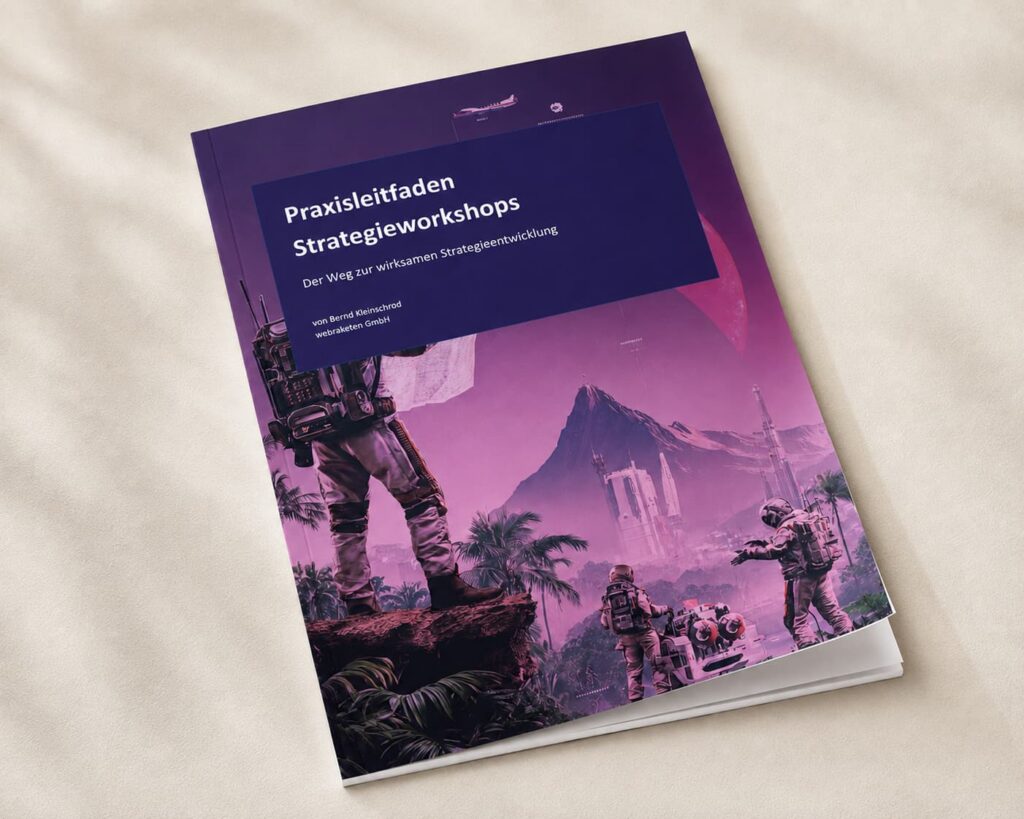
Free Download: Practical Guide
















Ten sections. Each point jumps directly there.
No more fruitless meetings and conflicting priorities. We use a Proven, structured strategy framework, to unite your team in record time and create operational clarity.
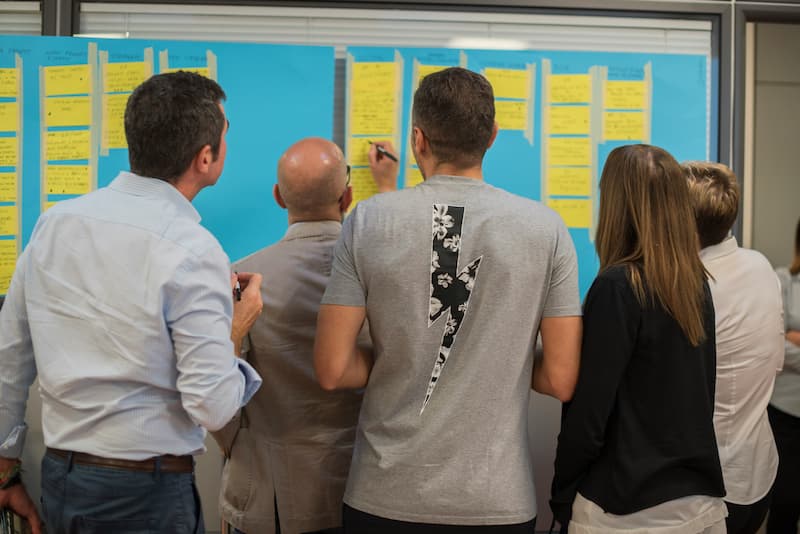
- Strategic clarity instead of endless discussions
- Defined, practical goals & KPIs
- Concrete Action and Implementation Plan
- Clear priorities
- External Moderation
What a strategy workshop is — and what it isn't
A strategy workshop is a facilitated format in which a team defines three things in a set amount of time: a shared goal, the criteria by which the achievement of the goal will be measured, and the plan to get there.
The difference from an ordinary strategy meeting lies not in the duration, but in the compulsion to make a decision. At the end, there is no minutes document with open items, but a direction that everyone stands behind — even those who were initially against it.
One day is enough to gather ideas, but not to make a decision. From the third day on, the format loses the pressure that forces a decision. Two days cleanly separate the two: day one opens, day two closes.
One goal instead of five priorities
The team agrees on an overarching goal that everything else aligns with. Not a list where every department gets to include its own point.
Measurable, not euphonious
Every goal includes two to three hard metrics. A goal whose failure no one can detect is not a goal, but a statement of intent.
A schedule with names and dates
Every initiative on the roadmap has an owner and a date for the next check-in. Without these two details, the plan remains just meeting minutes.
No team event. Cohesion happens naturally, it is not the goal.
No training. Nothing is being negotiated, decisions are being made.
No outside strategy. The content comes from the team, not from a slide.
No detailed planning. Depth of implementation belongs in the weeks that follow.
The framework at a glance
The most important details are summarized here so you can assess in advance whether the format fits your calendar. They are answered in detail in the FAQs.
2 days
From 09:00 to 17:00 each, with fixed breaks. Day one opens, day two decides.
5 to 8 people
Decision-making authority must be in the room. A pre-designated decider makes the choice in case of doubt.
On-site or remote
On site in your premises or at a neutral location. Remotely via video conference with a digital board.
An initial consultation
No preparation effort required for the team. We will clarify the initial situation and the circle of participants in advance.
External, throughout
Both days hosted by the same person. No change, no handovers.
Roadmap with owners
Main goal, success metrics, three to four chosen concepts, timeline, persons responsible, check-in dates.
Typical situations where a strategy workshop is worthwhile
Six typical situations where two focused days accomplish more than months of parallel solo efforts.
AUnclear strategy & goals+
Either no strategy exists, or it's a poor one. Unclear strategies are often full of buzzwords („agile," „AI," „leadership," „sustainable," „disruptive") and vague goals.
Such goals are often formulated so vaguely that they can never officially be considered „failed." This way, in the end, everyone works on different goals.
Everyone is moving somewhere, but they all arrive at different places – resulting in a lack of team success.
BEverything is priority 1 - and therefore nothing is important+
20 initiatives are all simultaneously competing for the budget and resources of what should really be only three projects. The team is overloaded, projects are only half-finished, and there's a lack of courage to say no to things sometimes.
A good strategy decides for A and against B. A bad strategy often tries to do everything at the same time.
CStrategies between the ivory tower and the drawer+
A strategy is often devised „from above" without considering the reality of those who will ultimately have to implement it.
As a result, cynicism prevails at grassroots level because the plans fail to address real day-to-day business. At the same time, there is no system in place to make progress measurable.
Without clear responsibilities and tracking, the strategy has no influence on day-to-day activities.
A good strategy requires a close alliance between vision and practice. It is not a one-off event.
Real change only occurs when the team accepts the goals and the implementation is consistently monitored.
DThe task is known. But the plan is missing.+
Website-Relaunch, marketing strategy, market entry, product launch and much more: the team knows the tasks and challenges.
But there are too many opinions on possible solutions and therefore no agreed plan on how to actually achieve the goal.
Either you get caught up in discussions or teams go in different directions. It is decided early on whether projects are successful or not.
EManagement changes and restructuring+
New team lead, new management, internal restructuring: Instead of entering a months-long „discovery process," a strategy workshop helps find clarity in two intensive days.
Sometimes this also demotivates teams and they lose their „drive".
A joint workshop creates clarity and commitment and brings new energy to everyone involved.
FBudget reset+
It sounds contradictory at first, but it makes perfect sense: when budgets are cut, investments should be made in a new strategy.
If the budget becomes tight, the strategy must be sharpened. Resources must be deployed on point in order to achieve the unchanged high targets.
A strategy workshop helps with the realignment.
Inaction burns money.
Many companies see a strategy workshop as an „extra investment.“ However, the real costs arise where there is no clarity. Those who save time on strategy pay for it double and triple later on.

Friction instead of returns — the invisible bill.
-
›Friction instead of returns: when teams neutralize each other
It’s not that the different teams aren’t working. In fact, they’re often working at their limits. But without a common goal, everyone is heading in different directions. As a result, everyone ends up in different places. The teams contribute 100 % of energy, but the outcome is only 20 %. The rest is eaten up by internal coordination loops, duplication of effort, and mutual obstruction. That’s not productive work—it’s costly friction.
-
›Costly long-term consequences: Why „just getting started“ costs ten times as much
Starting a project without a strategy – whether it's a website relaunch or market entry – is like building a house without structural engineering. You often only realize on the second floor that the foundation isn't holding. Every course correction that is only noticed during implementation (during design, programming, or rollout) costs ten times as much as clean strategic planning would have cost. Those who skimp on thinking end up paying „misplanning interest“ when they do the work.
-
›Hesitating while the competition is already sprinting
While no clear direction has yet been declared internally, the competition is already creating facts. The opportunity costs of inaction are often higher than the risk of making the wrong decision. Market shares that are lost today due to hesitation will have to be laboriously bought back tomorrow for a multiple of the budget.
-
›Talent erosion: the departure of the high performers
Nothing frustrates A-players more than lack of direction and „bullshit bingo“ strategies. When top talent feels like they are wasting their time in meaningless meetings or on aimless projects, they first quit internally – and then officially. The costs of recruiting, onboarding, and loss of expertise are massive. A clear strategy is therefore also always an investment in retaining the most important resource: your own talent.
Here's how the strategy workshop will proceed
Focus & Solutions
The first day is used to define the goal and develop concrete solutions without getting lost in details.
Decision & Plan
The second day transforms the ideas into a fixed plan.
-
›Step 1: Target definition
The team defines an ambitious, overarching goal. This „North Star“ serves for further orientation. Instead of endless debates, a binding main goal is selected through a special, goal-oriented decision-making process and final approval by a pre-defined decision-maker.
-
›Step 2: Define success metrics
A goal is only as good as its measurability. The team defines two to three hard metrics by which the achievement of objectives can be measured.
-
›Step 3: Concept development
This is how everyone is heard: Each participant silently develops a concrete strategy idea (concept) that will be seen and evaluated by everyone on day 2.
-
›Step 4: Selecting the strategy
Through Heat Map voting, the most promising approaches are identified without extensive discussions. The decider then selects the top three to four concepts to be implemented.
-
›Step 5: Roadmap & commitment
The selected concepts are placed on a timeline (e.g. next 3 / 6 / 9 months). An owner (person responsible) is named for each initiative on the roadmap and a date is set for the next check-in. The focus here is less on detailed operational planning.
-
›Step 6: Conclusion & outlook
The decider gives the final „go“ for the roadmap. The workshop concludes with a clear distribution of next steps.
Beyond: Follow-Ups
A strategy workshop is a proper and important component for the success of your projects. But it's only the beginning.
Subsequently, regular, joint follow-ups are worthwhile to review the roadmap and KPIs.
In our fast-paced world, even fundamental prerequisites can change quickly. In individual cases, objectives may also need to be adapted.
The most important thing is to keep at it after the workshop. Regularly review goals, KPIs and to-dos together.
How much a strategy workshop costs
A reliable figure without knowing the team size and starting point does not exist — neither from us nor from anyone else. What can be said in advance: what the price depends on and what is included in the respective format. You will receive the concrete figure after the initial consultation, in writing and without off-the-shelf package prices.
Depending on the number of participants, the effort for preliminary discussions and follow-up work, and whether follow-ups are part of the assignment. Not on the number of topics: A workshop with a clear goal is cheaper than one in which three conflicts are to be resolved simultaneously.
One day, small team, a defined topic
Preliminary discussion, moderation, result documentation.
The format of this page
Initial consultation, moderated throughout both days, Strategy Signal Board, priority list and roadmap with assignees.
Workshop plus follow-ups over the first few months
Everything from the two-day format, plus regular follow-ups on the roadmap and KPIs.
Not the workshop against zero, but the workshop against the costs of hesitation: Two days cost less than a quarter in which six people work in different directions. What that means in concrete terms is in Section 04.
Free in advance: In the initial consultation, we will tell you whether the format is worth it for your situation — and if not, what is instead. Free of charge and without obligation. Request strategy analysis →
Workshop, sprint or consultation
Three formats that are often confused because they all start with „we need a direction.“ They differ in what is produced at the end and who developed it.
Set direction: a goal, metrics, roadmap with owners. The content comes from the team.
2 days
your team has different views on the priorities and has to make a decision
Build a concrete solution and test it on the user. The result is a tested prototype, not a direction.
4 – 5 days
the direction is set and a product or feature needs certainty before implementation — more on this
External analysis and recommendation. The result is a concept that must then be defended internally.
Weeks to months
Market data, benchmarks, or an external perspective that no one internally can provide are missing.
The same goal, without external moderation. Cheap, but the moderation is part of the agenda.
variable
the fronts have not hardened and nobody in the room prefers a specific outcome
The most common misstep is sprinting without a prior direction: the result is a well-tested prototype for a goal no one agreed on. Conversely, a strategy workshop is superfluous when the direction has long been set and only the execution is unclear.
What our customers say

„The biggest effect wasn't the result on the board, but the subsequent calm. Decisions suddenly became quick because we had a common reference point. The strategy workshop didn't motivate us, it focused us.“
„Before the workshop, meetings were sometimes a political minefield. Everyone had a different idea of what the priorities were. The strategy workshop didn't solve that by making everyone happy, but by giving a clear direction that no one could escape anymore.“

„We had too many opinions and too few resources. After two days, it was finally clear what we were really working towards, what success specifically means, and what we consciously would no longer do. This ended discussions and we finally got to implementation.“
The timekeeper for radical clarity
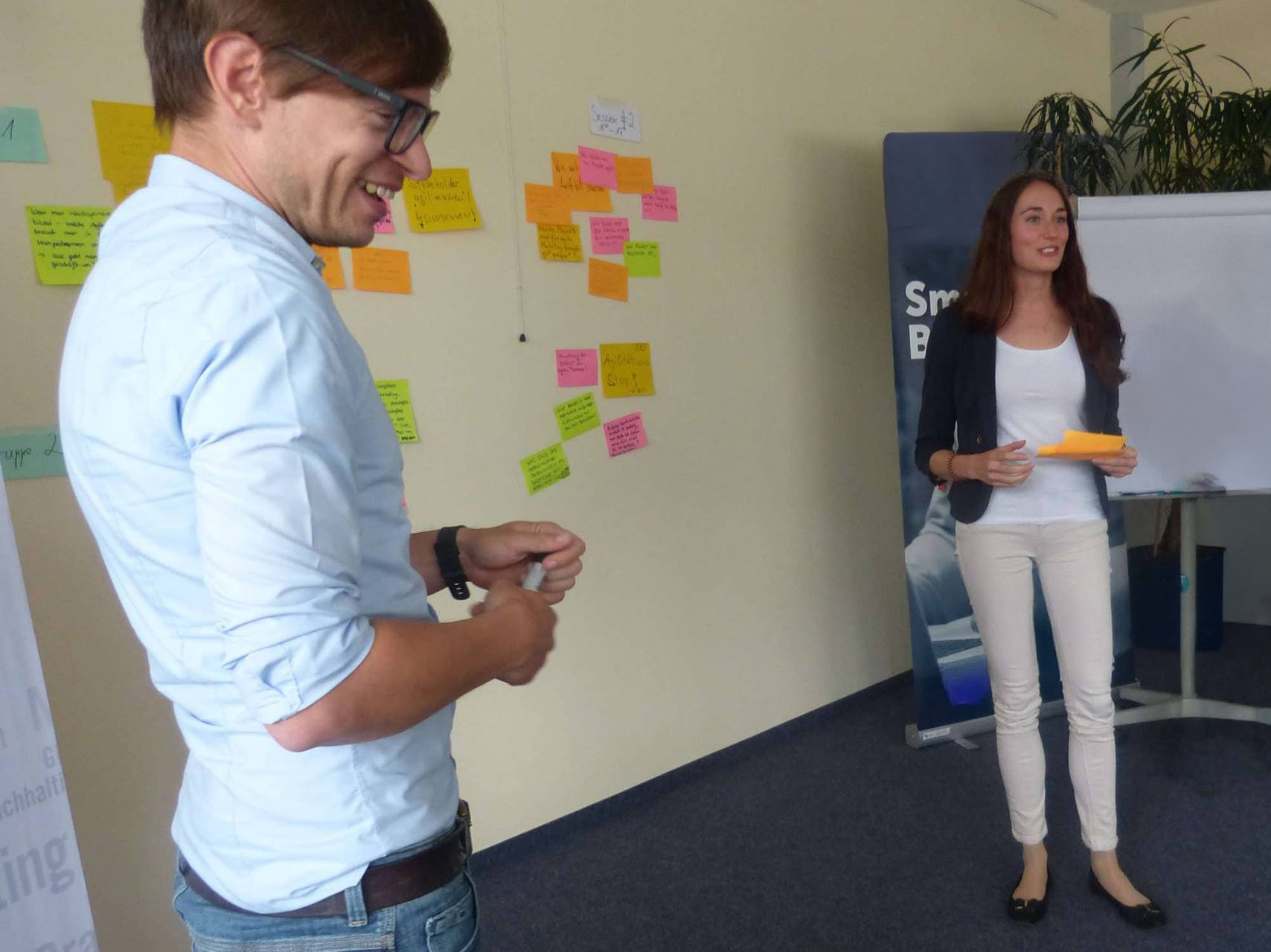
A strategy workshop lives or dies by its moderation. Bernd isn't a theorist explaining models: he's the compass when discussions get heated and the anchor when the focus is lost. He moderates as an equal because he bears the „scars from practical experience“ himself.
- The incorruptible view from the outside: As an external moderator, Bernd is not entangled in internal structures. He sees the blind spots, asks the uncomfortable questions, and immediately recognizes when discussions are drifting off course and are not productive.
- Experience from both worlds: As an agency owner, he understands the executive perspective, which is focused on results, as well as the day-to-day challenges faced by the teams. He has experienced these situations himself more than enough times. This „been-there-seen-that“ attitude provides the confidence to arrive at reliable critical decisions.
- Structure junkie with target guarantee: As a moderator, he ensures that no one gets lost in details and that the main thread is maintained. He does not moderate endless debates but consistently leads to a result that will truly hold up in practice.
- Empathic provocateur: He senses the vibes in the team. Bernd moderates with tact and sensitivity, but is not afraid to put his finger directly in the wound when a decision is being avoided.
- Focus Guarantee instead of Presentation Corpses: His claim is that after 48 hours, not only a plan will be in place, but also the clarity and energy to implement it directly in the following weeks.
„"I don't bring ready-made solutions for your business—but I do bring the framework and practical experience needed to help your team come up with the best solutions. My goal is achieved when, by the end of the two days, you once again know exactly what to do and why.""
The Takeaway Guide
Everything written in these ten sections has been detailed by Bernd in a practical guide—around 30 pages on the preparation, execution, and follow-up of a strategy workshop. Also useful if you are moderating the workshop yourselves.
Ivory tower and drawer, the time paradox, „everything is priority 1", and the trend trap.
Core team, the ego trap, the decider against the consensus trap, and the role of moderation.
From the search for the North Star to strategy selection and the finished roadmap.
Endless discussion loop, HiPPO dominance, internal bias, beautification diagnosis, time management, and the illusion of savings.
Practical Guide to Strategy Workshops
Register briefly, then the download is ready. No sales pitch, no calls.
End the expensive disorientation.
Free Initial Consultation for Strategy Analysis – 100 %, no obligation
Frequently Asked Questions
01What does a strategy workshop cost?+
The investment depends on team size and scope. But the more important question is: What does it cost the company if no decision is made? As a rule, the workshop pays for itself very quickly.
02Where does the workshop take place?+
We align with your needs and the desired impact. Three proven formats are available:
- Onsite Right at your location. We come directly to your company. It’s personal, highly efficient, and saves your team valuable travel time.
- Offsite Escape the everyday, enter clarity. Sometimes you need to change your perspective to regain your vision. We have already conducted workshops in inspiring locations. Whether in the tranquility of the Allgäu or under the sun of Mallorca or the Canary Islands. The advantage: The physical distance creates mental space and allows the team to grow together on a deeper level. This intensity can be ideally combined with on-site team-building activities to sustainably anchor the new momentum.
- Remote Digital, direct, location-independent. For distributed teams or when speed is of the essence: we conduct workshops via video conference. Using established digital collaboration tools, we achieve razor-sharp results even in the digital space. This is the most cost-effective option, offering full flexibility with minimal organizational effort.
03How much time do we need to invest?+
Ideally, the workshop should be spread over 2 days. This way, insights can be better processed in between. However, these are not full 8-hour days.
In extreme cases, this can also be compressed into one day. However, this is not recommended as it will then be a very intensive day and experience has shown that the quality of the results will suffer.
04Do we need to prepare for the workshop?+
Minimal. We’ll send you a brief checklist in advance. We’ll handle the rest together during the workshop. There’s no need (or rather, no reason) for PowerPoint battles. All we need are the challenges and your expertise.
05What role does webraketen play in the workshop?+
We are the architects of the process and the breakwaters against endless discussions. So that the team can fully concentrate on the topics, we take care of the framework:
We are the pacemakers: We moderate, structure, and keep the pace up. We ensure that time is used optimally, everyone is heard, and we have real, resilient results on the table at the end of the two days. If conversations threaten to drift into „bullshit bingo“ or the group starts going in circles, we bring everyone back on track.
What we consciously don't do: Subject matter input. You and your team are the experts on business, customers, and products – not us. We hold back on content because we are convinced that the best solutions are already within the team. Our job is not to dictate what needs to be done, but to guide you with the right methodology to figure it out and decide for yourselves.
We provide the system—your team provides the substance. By making this clear distinction, we ensure that the strategy is ultimately 100% „yours“ and not that of an outside consultant, which ends up in a drawer after two weeks.
06Who should attend the workshop?+
Strategy is teamwork, but too many cooks in the room kill speed. To ensure the workshop has the necessary impact, we recommend a group of 5 to a maximum of 10 people.
The ideal composition consists of three rolls:
- The decision-makers: At least one person must be present who can say „yes“ or „no“ at the end (CEO, founder, or team lead). Without final decision-making authority in the room, we risk the results being „talked to death“ later on.
- The bridge builders: This includes people who have different perspectives on the business. Typically, these are the minds from Sales (customer's perspective), Marketing (market's perspective), and Product/Engineering (feasibility's perspective).
- The realists: Integrate 1-2 people who will be responsible for implementation later. If the people who „do the work“ are involved in developing the plan, acceptance is many times higher afterwards.
Our tip: Choose people who are not afraid to speak their mind. A good strategy process thrives on honest friction. If everyone just nods, we are burning potential.
07What will we have in our hands after the two days?+
There is no 80-page PDF corpse gathering dust in the „Strategy_V04_final“ archive folder after three days. We produce results that can be acted upon immediately.
Specifically, the workshop concludes with:
- Democratic Strategy Signal Board: A crystal-clear visual overview (analog on paper or digital in tools like Miro) that summarizes the strategy at a glance. No lengthy searching – one look is enough to know where the journey is headed.
- The radical list of priorities: We have jointly decided what is Prio 1 and what is not. In the end, there is a list of projects that will be stopped so that there are finally enough resources available for the really important things.
- The 90-day march plan: We're breaking down the big strategy into small, digestible chunks. Everyone knows exactly which milestones are to be reached in the next three months and who is responsible for them.
- Clear responsibilities: No „one would have to“. We define who is responsible for which result. This creates commitment and puts an end to the tedious alignment ping-pong.
- Full alignment in the team: You don't hold the most valuable result in your hand, you can feel it: Everyone in the room has the same view of the goal. The time of guesswork and working against each other is over.
The goal of Strategy Signal is for your team to come into the office on Monday after the workshop and no one will have to ask, „What are we actually doing first?“ – because everyone knows.
08How does the approach of classical management consultancies differ?+
If you're looking for someone to move in for six months, build 150-page PowerPoint presentations, and explain their world with complicated buzzwords, you've come to the wrong place.
We differ in three essential points:
- Sprints instead of marathons: Traditional consultants love long project durations. We love speed. Strategy Signal is designed to provide the clarity in just two days that traditional consultancies often need months for. We are the turbo, not the long-term parker.
- Process competence instead of know-it-all: Traditional consulting firms often rely on „off-the-shelf“ industry solutions. The problem: These rarely fit 100 %. We don’t presume to know your business better than you do. Instead, we facilitate the process so that the solution comes from your own team. This ensures genuine buy-in („ownership“) rather than resistance to „the top-down approach.“.
- Implementation instead of PDF corpses: Our goal isn't a beautiful report, but a functional system. While traditional concepts often fail due to implementation complexity, we break everything down into radically simple, measurable steps. The result isn't theory, but a tool you can start using directly next Monday.
In short: Traditional consulting firms often sell the „what.“ We provide the „how“—your team decides on the „what“ and takes action on its own.
09What happens if we don't agree in the workshop?+
That's exactly what we're here for. As external moderators, we mirror the conflicts and guide through structured decision-making processes. Our concept is designed to achieve „alignment“ not through consensus (everyone gets a little bit), but through clarity (we decide on what's best).
10How do we ensure that the strategy doesn't „fall asleep“ again after two weeks?+
That is the most important point. Our framework includes an integrated tracking system with follow-ups. In the workshop, we precisely define who delivers what results and when, and how progress will be measured. Optionally, we provide follow-up support with regular „signal checks“ to stay on track.
11Does the strategy workshop also work in our specific industry?+
Short answer: Yes. Long answer: Absolutely.
It's a common misconception that a strategy method only works if the facilitator has known the industry for 20 years. We see it differently:
- Strategic problems are human, not industry-specific: Whether a company develops software, builds machinery, or works in healthcare – the pain points are the same everywhere. „Everything is priority 1,“ vague goals, and friction due to poor alignment are universal organizational problems. Our framework dissolves precisely these structures.
- You are the experts on the content, we are the experts on the process: We don't presume to understand your business better than you do. Nobody has to pay for that. Your team brings expertise, market knowledge, and experience to the table. We bring the methodology, structure, and impartial moderation to forge a sharp strategy from this knowledge.
- The „outsider perspective“ is the biggest leverage: Often, people are so deeply rooted in their own industry that they can't see the forest for the trees („tunnel vision“). The fact that we are not trapped in daily industry dogmas allows us to ask the critical questions that no one else is asking. This is often the breakthrough needed for true innovation.
Strategy Signal is the operating system for your decision-making. And this operating system runs stably – no matter what software (industry) you run on it.