
Query fan-out is the retrieval stage within RAG-Systems (read here: Retrieval Augmented Generation).
Instead of merely matching a query („search“) against a list of results, a generative model creates multiple intent-differentiated sub-queries, runs them in parallel, and builds the answer in passages from the results.
This is primarily triggered by complex, comparative, or multi-criteria queries. Much less so, however, by factual questions.
For content creation, this means: a page no longer competes for a single keyword, but rather for whether it is the best provider of passages for multiple parallel sub-intents. The Keyword research thus turns into intent analysis.
Differentiation from the similarly named „fan-out“
The term clashes with two established meanings: „fan-out“ in software development and messaging (a distribution pattern in which one message goes to multiple recipients) and „fan-out“ in electronics (the number of inputs an output can drive). Confusion is easy because all three share the same image - one source spreading to many targets. However, here we exclusively mean the retrieval process in AI search: same name, different subject. Anyone looking for the messaging or electronics concept is in the wrong place.
How a Query Fan-Out Works (And When It's Triggered)
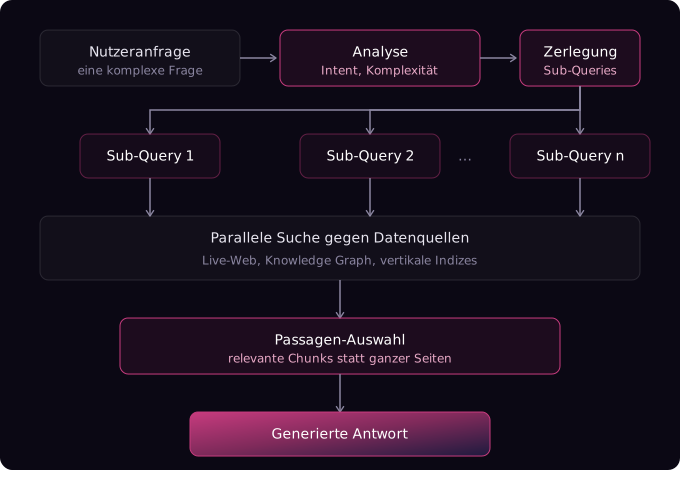
The process follows four steps:
- Analyze: The system analyzes the request with NLP models for intent, complexity, and required response type.
- Decision: The system decides whether fan-out is sensible.
- Activation: Upon activation, a generative model creates parallel sub-queries. These run concurrently against multiple data sources, such as live web searches, knowledge graphs, potentially shopping graphs, or vertical indexes.
- Generation: The answer then does not arise from entire pages, but from passages: Relevant „chunks“ from the retrieved documents are selected and woven into the answer.
Depending on the AI system, not every request triggers a fan-out. Factual short questions like „What is the capital of Spain?“ are usually answered directly.
In contrast, complex, comparative, or multi-criteria questions activate the mechanism: „How do I optimize the performance of a Website“
Google has the procedure at I/O 2025 officially described: AI Mode break down the question into subtopics and pose „a multitude of queries simultaneously“ (see also I/O 2025 Takeaways).
Google's Deep Search uses the same technique in a scaled-up form and can, according to its own statement, perform „hundreds of searches“ per user request.
8 Google Search Query Types
Google itself divides a user's query into 8 sub-query types.
This is for SEO fascinating in that one can also draw conclusions for content creation from the respective sub-query type, in order to precisely Such an intention to serve the user perfectly.
For the origin of the typology, a brief derivation is important beforehand: The formal mechanism originates from two Google patents.
- Query Variant GenerationUS11663201B2)
- Thematic Search (US12158907B1)
Google itself has only been publicly using the term „query fan-out“ since I/O 2025. In the patent text linked above, it is still called "query variant generation.".
However, the eight variant types mentioned in US11663201B2 are different from those commonly used in SEO practice. The patent itself lists equivalent, follow-up, generalization, canonicalization, language translation, entailment, specification, and clarification.
The eight types listed below are not the patent wording, but rather an interpretation established in the SEO community (e.g., iPullRank, Wellows) that is based on the patents and translates them for content practice.
This eight-type logic provides a reproducible framework for checking which branches a page already covers and which are missing:
- ReformulationThe same intention, different wording („CRM software“ → „customer management tools“).
- ImplicitImplicitly implied context that the user does not state („CRM software“ → „CRM software for small teams“).
- Entity ExpansionExpansion with connected entities, brands, products („CRM Software“ → „Salesforce vs. HubSpot“).
- ComparativeComparison to alternatives, „vs“ inquiries, selection decisions.
- PersonalizedVariations depending on role, industry, experience level („CRM for Mechanical Engineering,“ „CRM for Beginners“).
- RelatedThematically related questions about the seed.
- Definitional / CategoryWhat-is questions and categorizations.
- EquivalentSynonyms or semantically equivalent formulations.
The typology only becomes meaningful when you work through it with a concrete seed.
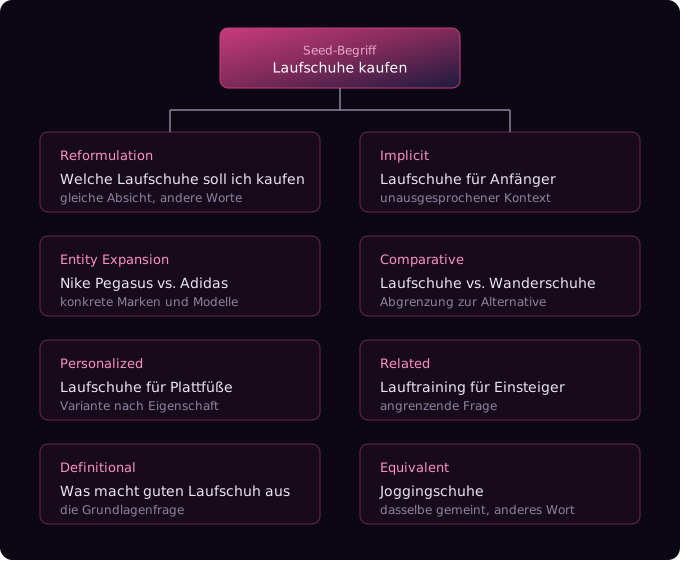
An everyday example with the search query (seed) „buy running shoes“:
- Reformulation What running shoes should I buy.
- Implicit Running shoes for beginners.
- Entity Expansion Nike Pegasus vs. Adidas – specific brands and models are implied.
- Comparative Running Shoes vs. Hiking Shoes: Delineating the Alternative.
- Personalized Running shoes for flat feet - Variation according to personal characteristic.
- Definitional = „What makes a good running shoe“ - the what/fundamentals question.
- Equivalent „Running shoes“ - same meaning, different word.
Important for managing expectations: The specific sub-queries generated are not stable. The eight mentioned types are reproducible, but the exact wording is not. This is because AI systems are so-called black-box systems.
What Query Fan-Out means for content creation
When a query breaks down into multiple sub-queries and the AI selects passages, the overall page no longer determines visibility, but rather individual sections. This results in a structural logic that differs from classic keyword optimization and creates three recurring pitfalls:
- to create one page per phrasing variant
- to do keyword stuffing
- or Fan-Out as an extended keyword list
A viable page structure answers the main question at the top in a compressed form (TL;DR block), then uses H2 headings for each intent branch (definition, comparison, use case, differentiation), and addresses implicit and comparative sub-queries in their own sections, not within subordinate clauses.
Important: Always keep the user in mind, not the AI search engine.
What does the user *really* want to know? That's exactly what Query Fan-Out does.
Consolidate instead of fragment
The urge to create a separate page for each phrasing variant is usually not productive. This fragments thematic depth and distributes relevance signals across multiple thin pages.
It's better to create a main page that answers multiple sub-query branches in clearly structured sections. Sub-topics that are self-contained enough (like a full comparison or an industry application) will become their own pages (and be linked from the main page).
The rule of thumb is: consolidation is the default, fragmentation requires justification beyond phrasing.
Consciously use comparison and clarification subqueries
The two sub-query types, Comparative and Implicit, belong to the so-called decision-related sub-query branches because they typically arise during the decision-making phase. They are regularly overlooked.
Those who describe „X“ without addressing „X vs. Y,“ „When is X worth it,“ or „X for [Role/Industry]“ leave these branches to other sources.
In practice, this means: at least one explicit comparison section per main page and a section on typical context assumptions (company size, use case, prerequisites).
FAQ blocks are a suitable format for this, as long as the questions come from actually observed sub-queries and do not serve as filler material.
Why Classic Viewability Measurement Fails with Fan-Out
Sub-queries from fan-out processes do not appear in Google Search Console. Only the original user query is visible there, not the eight to twelve derived sub-queries that internally led to the answer. Those who measure visibility in AI answers exclusively by classic GSC metrics do not see the mechanism that decides on visibility at all.
Added to this is the issue of stability: Since only about 27 % of the subqueries remain the same when repeated, it is not economically viable to optimize exhaustively for specific subquery formulations.
A two-step practice is more useful: For strategically important seed terms, simulate the actual fan-out using so-called fan-out generators, AI trackers, and visibility tools, which capture sub-queries from AI mode, perplexity, or ChatGPT.
For breadth, topical authority suffices as a proxy: a page that thematically covers the eight sub-query types along the seed has a higher probability of being selected as a source in multiple parallel retrieval runs.
How strong this effect is, is shown by a Surfer SEO Study over 173,902 URLs and 10,000 keywords (November 2025).
She found a correlation (Spearman 0.77) between the number of fan-out queries for which a page ranks and its likelihood of being cited in AI Overviews. Pages that ranked for the main term and at least one fan-out query were cited 161 % more frequently than pages that ranked only for the main term. The same study also provides the stability figure mentioned above: only about 27 % of the sub-queries remain constant across repeated runs. A complementary metric is citation in AI responses themselves—how often a domain appears as a source in response to defined prompts. A Semrush experiment observed an increase from two to five citations in a small sample of four articles following targeted fan-out optimization; the magnitude of this increase is useful as an indication, but not as proof of causation.
What else counts in the B2B and DACH context
Two effects are more pronounced in the B2B environment than in the consumer segment.
First, in DACH inquiries, fan-out often runs parallel in German and English because a significant portion of the technical terminology is in English. For example, „Predictive Maintenance,“ „Condition Monitoring,“ or „Digital Twin.“.
A German-language site that exclusively uses translations for key technical terms will not cover English sub-queries, and vice versa. Consistent dual listing in the running text (English technical term plus German equivalent) is useful, as is using both variations consistently in headings and FAQs.
Secondly, personalized and comparative sub-queries are highly differentiated in B2B. For solutions that require explanation, sub-queries arise that explicitly ask about role (maintenance manager, IT manager, purchasing), industry (mechanical engineering, process industry, energy), and maturity level (pilot project, rollout, existing system). A main page that only describes the solution without addressing these role and industry branches is missing precisely in the sub-queries that arise during the decision-making phase. The structural answer: Role and industry sections as fixed components in the page structure and not as optional attachments.