The use of the model helps marketing and sales align content and activities with the buyer's perspective. It is primarily used in content and inbound marketing as a framework for content planning.
The Buyer Journey is often confused with the Customer Journey. While the Buyer Journey ends with the purchase (Decision), the Customer Journey continues afterward (Retention and Advocacy).
In contrast to the sales funnel, the buyer journey adopts the buyer's perspective – the sales funnel describes the internal company view.
This shift in perspective from internal (What do I want to convey in marketing?) to external (What does the potential customer actually want?) is, by all experience, very valuable, as marketing messages can be more efficiently aligned.
Where the model comes from
HubSpot shaped the Buyer's Journey. The provider has established the term as the core of its inbound marketing methodology since the mid-2000s. It is therefore less an empirically discovered buyer pattern than a planning framework. Marketing practitioners created it to link content to the information needs of potential buyers.
This origin shapes the model's character: it is conceived normatively, meaning as a map for content strategy, not as a description of how people actually shop.
Those who use the buyer journey with this perspective avoid the most common misconception: confusing the model with actual buyer behavior.
The three phases in detail
Each phase represents a specific state in the buyer's mind and thus a different information need.
Whoever wants to assign a phase should check which question the buyer is currently asking, not which product or format is being marketed.
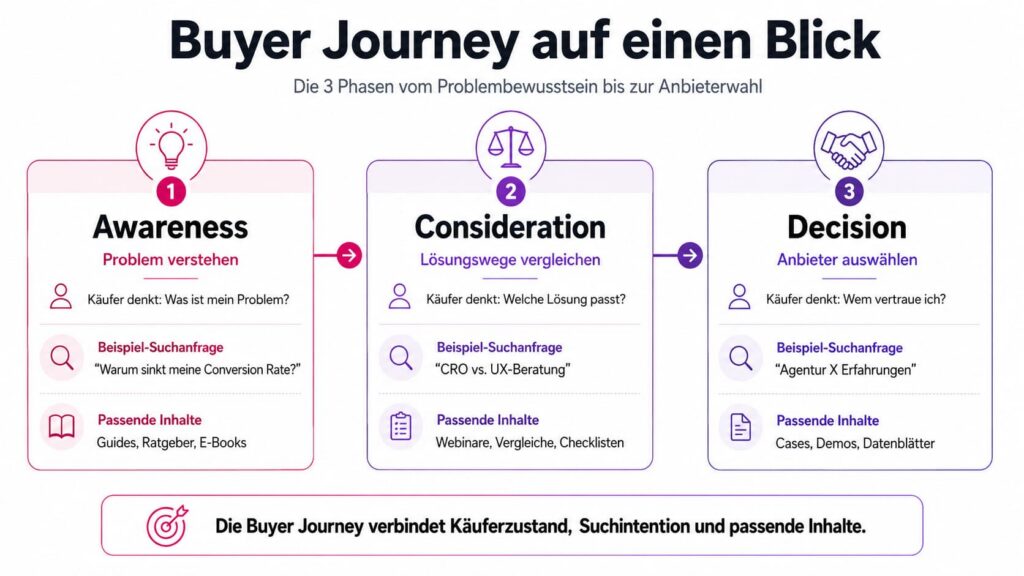
Awareness: The buyer recognizes a problem
In the awareness phase, the buyer realizes they have a problem or a need. They don't have a specific solution in mind yet. The typical search targets problem understanding and causes, such as „Why is my conversion rate dropping?“ or „What is SEOSuppliers, categories, or prices are not yet relevant here.
Suitable formats are those that provide context and clarify: e-books, guides, and tip sheets. The error at this point is to place product content for which the buyer has no framework yet.
Consideration: the buyer compares solution paths
In the consideration phase, the buyer has identified the problem and explored various solutions.
Categories of solutions are compared, not individual providers. For example, someone with a declining conversion rate is weighing whether Conversion Rate Optimization, an A/B testing tool, or UX consulting is the right way.
Key formats are expert webinars, checklists, and white papers that compare solution categories. Search terms are shifting from „What is X?“ to „X vs. Y“ or „Pros and cons of X.“.
Decision: the buyer chooses a provider
In the Decision phase, the solution category has been decided upon. Now, the focus is on the specific provider, price, and conditions. The purchase isn't finalized yet, but the selection has been narrowed down. Search queries like „compare inbound marketing agencies“ or „provider X price“ are typical signals.
Here, product data sheets, vendor comparisons, case studies, and demo offers are suitable. In B2B, an additional need often arises: material that internal advocates can use to justify a business case to colleagues and decision-makers.
Buyer Journey, Customer Journey, or Sales Funnel?
The three terms are confused, but they differ in perspective and timeframe.
The buyer's journey takes the buyer's perspective and ends with the purchase decision.
The customer journey encompasses the entire customer lifecycle and continues after the purchase, for example, with onboarding, retention, and referral.
The sales funnel maps the same phases as the buyer's journey, but from the company's perspective: many prospects at the top, few buyers at the bottom, with the focus on closing the deal.
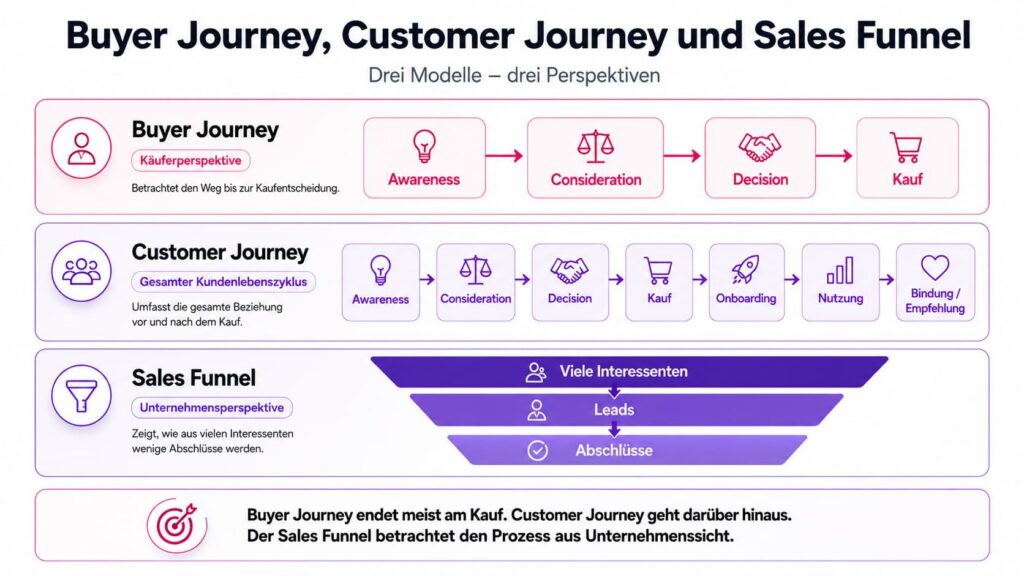
Practically, this means: Anyone who wants to win new leads and engage them in their decision-making process plans with the buyer journey. Anyone who wants to retain customers and turn them into recommenders plans with the customer journey. The sales funnel is the appropriate model when the question is how many prospects are lost at each stage and where the bottleneck in one's own sales process lies.
The user journey does not belong in this series. It describes user interactions within a digital product, such as an app or Website, and does not cover the purchase decision process.
How to assign content to phases
The practical benefit of the buyer journey lies in assigning a phase to each piece of content and making gaps visible. The fastest way to achieve this is through the search intent behind a request.
- Informational search queries Questions like „What is SEO?“ or „Why is my conversion rate dropping?“ belong to the awareness stage.
- Comparative Search Queries „Content Marketing vs. Performance Marketing“ or „Checklist for Marketing Automation“ belong to the consideration phase.
- Transactional and provider-related search queries Searches like „compare inbound marketing agencies“ or „Provider X reviews“ belong to the decision phase.
For formats, the rule of thumb from inbound marketing practice applies: In awareness, ebooks, guides, and tip sheets are suitable; in consideration, expert webinars, checklists, and solution comparisons are suitable; and in decision-making, product data sheets, vendor comparisons, and case studies are suitable. An inventory of one's own content along this allocation usually shows where a phase is undersupplied.
Why the real journey is rarely as linear as the model
Real buyers rarely follow the theoretical path of awareness → consideration → decision.
Google has shown with the „Messy Middle“ model that consumers repeatedly oscillate between exploration and evaluation between the trigger and the purchase.
In a study of 310,000 purchasing scenarios, about one-third of consumers changed their brand preference when competitors were specifically associated with cognitive biases (social proof, scarcity, authority, and others). In one extreme case, a fictional brand gained 87 % of buyer preference.
This empirical finding contradicts the three-phase model only superficially. The model does not lose its usefulness when buyers jump back.
It remains a card for content strategy because content can still be assigned to a dominant information need. However, it's not suitable as a forecast for an individual's path through the sales process.
The practical consequence: Think linearly in content planning, non-linearly in distribution and channel strategy.
Because the same buyer can view the same consideration content multiple times and in any order.
Common Mistakes When Working with the Buyer Journey
The most common mistakes in practice are documented and repeat themselves regardless of the marketing organization's maturity level.
- Too much focus on a single phase. Often, a lot of awareness content is created, while consideration and decision remain underserved. The result is leads that get stuck in the funnel because they don't find suitable content in the crucial phase. Correction: Count content inventory per phase, not overall.
- The reverse case in internal workshops. When sales and product teams gather content ideas, a large number of decision-stage topics emerge almost automatically, with hardly any genuine awareness content. The reason: They have their own product in mind, not the buyer's initial problem. Correction: Gather awareness ideas separately, starting from buyer questions without product reference.
- The completed Journey Map document. If the mapping is created once and then not maintained, it will become outdated faster than the product and target audience. Correction: Treat the mapping as a living document that is updated with new buyer questions and content formats.
- Content gaps in critical objections. Content is often missing for a specific persona concern, for a documented objection from sales conversations, or for the internal business case in decision-stage purchases. Correction: Systematically feed objections and recurring questions from sales conversations back into content planning.
FAQ
Is the buyer journey the same as the purchase journey?
Both terms are largely used synonymously and refer to the purchase decision process from the buyer's perspective. „Purchase Journey“ is common in the context of Google and consumer behavior research, while „Buyer Journey“ is used in content and inbound marketing.
Does the buyer's journey differ in B2B and B2C?
The three-stage framework remains the same. However, the B2B journey typically involves more decision-makers, higher stakes, and longer timeframes. For B2B purchases, the decision stage creates an additional need for materials that an internal advocate can use to justify the business case to further decision-makers.
Does the buyer journey have three or five phases?
Canonically, there are three: Awareness, Consideration, and Decision. Five-phase variations, which additionally include Retention and Advocacy, mix the buyer journey with customer journey elements and are not a standard buyer journey model.
Where does the buyer journey end and the customer journey begin?
The line is drawn at the purchase decision. Everything before that, including needs recognition, solution comparison, and vendor selection, is the Buyer Journey. Everything after that, including onboarding, usage, retention, and recommendation, is the Customer Journey.