- Unaware
- Problem Aware
- Solution Aware
- Product Aware
- Most Aware
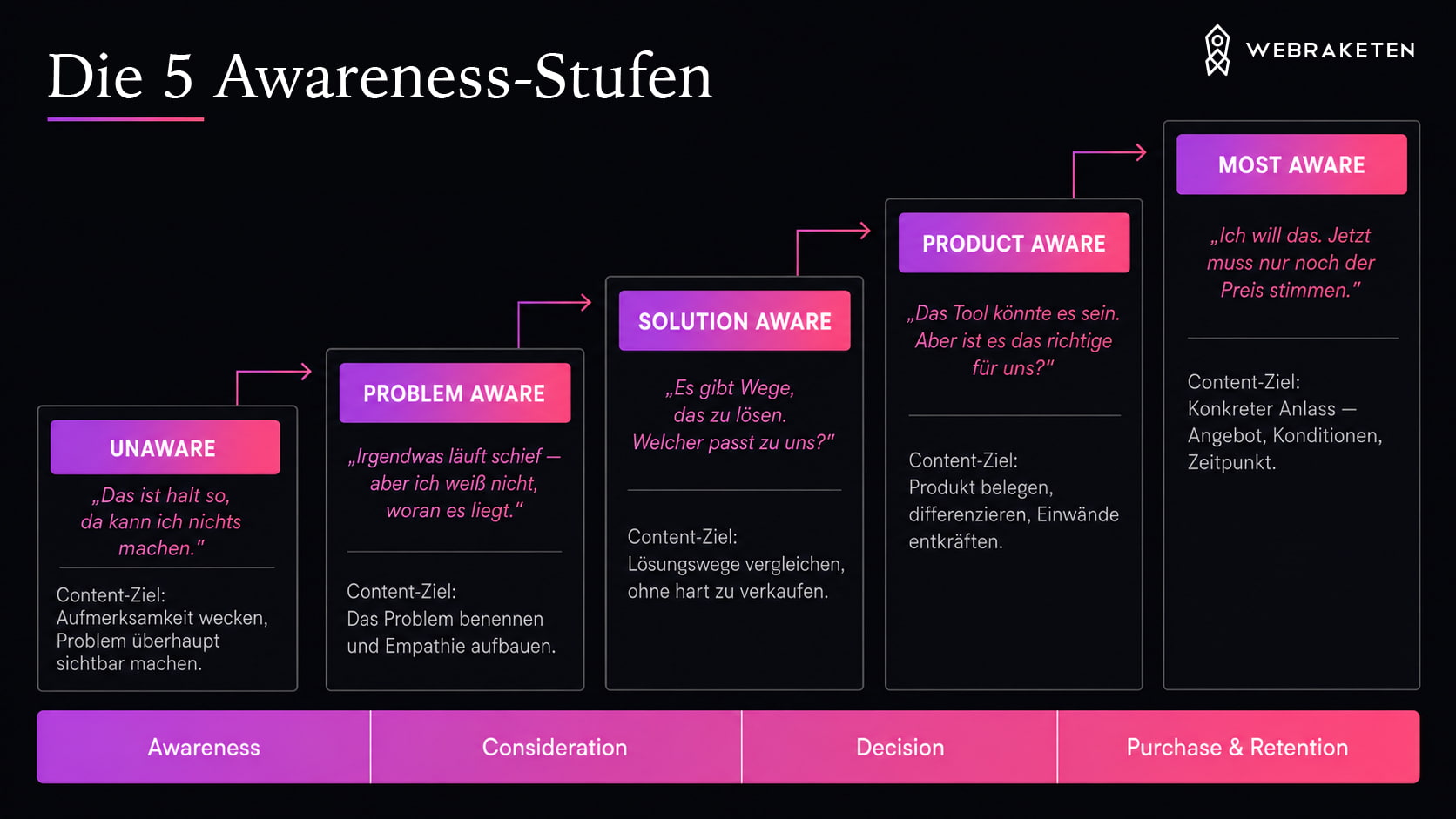
This subdivision helps in marketing to tailor a message to a person's respective level of knowledge, instead of communicating the same message to all recipients.
The model is used, for example, in copywriting, content strategy, or in Lead generation. Increasingly, the 5 stages of awareness are also being applied to content that is to be cited in AI search and LLM responses.
is about direct-response copywriter Eugene Schwartz and his Book „Breakthrough Advertising“ (1966) back.
Awareness levels are not the same as the Buyer's Journey- Phase „Awareness“ and not like „Brand Awareness“ in the sense of brand recognition. Both confusions occur regularly in German-speaking countries and are distinguished below.
The five stages of awareness
The stages differ in what a person knows about the problem, solution, and product. The order starts with the lowest level of knowledge.
Unaware. The person doesn't realize they have a problem or a need. Schwartz describes this state as the prospect being unaware of their desire or not admitting it to themselves. Typical thoughts related to this include: „That's just how it is, I can't change it.“ A product message misses the mark here because the frame of reference is missing.
Problem Aware. The person senses a problem or symptom but doesn't know the solution for it. They are looking for terms to describe what they are observing and for causes. Providers and products are not yet part of their search space.
Solution-aware. The person knows there are solution classes for their problem but hasn't decided on a path yet. They know the desired outcome but haven't assigned it to a specific product yet.
Product Aware. The person is aware of specific products or providers but is not yet convinced that a particular one is the right choice. They are comparing features, prices, references, and risks among known options.
Most Aware. The person knows the product and is ready to buy. Only the conditions, timing, or a specific occasion are still open.
Core principle: Align messaging with the state of knowledge
A statement is only effective if it aligns with the addressee's level of knowledge. What convinces a most-aware buyer – price, terms, deadlines – completely misses an unaware person. Conversely, explaining a problem is redundant to an interested party ready to buy.
This leads to a shift in perspective: away from the question „what do we offer“ towards „what can and does the person at their stage want to hear.“ The model therefore structures not the sales process, but the selection and order of messages. Most-aware individuals convert fastest, but are expensive in media competition. Content for the problem-aware and solution-aware stages builds a more cost-effective pipeline long-term.
In the same book, Schwartz describes a second model, the Sophistication Levels. It concerns the maturity of an entire market, not an individual's level of knowledge—and is often confused with Awareness Stages (see Differentiation).
Boundaries and common misunderstandings
It is important to understand that the order of stages in practice is not linear. Individuals may skip stages or revert to earlier ones, for example, when new information invalidates previous assumptions or an additional stakeholder is introduced.
The model describes possible states, not a fixed path.
A fixed breakdown of the levels is also commonly cited: approximately 60 % Unaware, 20 % Problem Aware, 10 % Solution Aware, 7 % Product Aware, and 3 % Most Aware.
You are referring to the size of the target audience per stage. How many of the potential buyers are currently in which state of awareness?
This would therefore indicate that the vast majority of a market doesn't even know they have a problem. Furthermore, only a small fraction is ready to buy.
However, this specific distribution cannot be substantiated. It circulates in secondary literature but cannot be cleanly traced back to Schwartz's original work. Therefore, it is suitable as a rough rule of thumb (‘most are unconscious, few are ready to buy„), but not as a reliable indicator.
Awareness Stages vs. Buyer's Journey
While the Buyer's Journey, with its three stages of Awareness, Consideration, and Decision, describes linear behavior in the purchasing process, the Awareness stages go a step further.
You are describing a cognitive state. How much does a person know in their head about their problem? How familiar are they with possible solutions? Do they already know specific products?
A buyer's journey implies a fixed sequence from A to B to C. The awareness stages are explicit. not linear. This also mostly aligns with the reality of the buying process. A person jumps back and forth between stages, for example, when new information invalidates previous assumptions.
This means the buyer's journey, with its three phases, is described much more coarsely than the awareness stages with their five „fluid“ states.
Awareness Stages vs. Customer Journey
Similar to the Buyer's Journey, the same applies to the Customer Journey. However, the Customer Journey is broader than the Buyer's Journey. It includes further phases after the purchase (decision), such as retention and advocacy.
This includes steps such as onboarding, usage, support, renewal, referral, and offboarding. It therefore considers the entire business relationship over the customer lifecycle, not just the initiation process.
Otherwise, the distinction to the awareness levels remains the same: The customer journey also describes a process. What does the person do and in what order?
The awareness levels, on the other hand, describe what it knows. One is a process over time, the other a snapshot of the knowledge state.
The big difference: Awareness stages only cover a segment of the customer journey. So, the mental state before and during the purchase decision.
What happens after the purchase is outside the model. A person can have been a customer for a long time and start again at problem aware for their next need.
Awareness Levels vs. AIDA
Also exciting is the perspective compared to the classic AIDA model (Attention, Interest, Desire, Action). Because AIDA merely structures the subsequent reaction to an already broadcast advertising message.
Awareness stages, on the other hand, describe the level of knowledge before the message. This helps to align the advertising messages much more precisely with the real problems, fears, and desires of potential customers.
Sophistication Levels. The second Schwartz model describes how many competing promises a Market has already seen. Awareness levels measure the level of knowledge individual person. Two different reference planes that are often confused.
Awareness Levels in B2B
In B2B, the application changes at three points compared to B2C.
First, awareness transitions rarely occur as a single "aha!" moment. Responsible parties notice recurring patterns over weeks or months—unanswerable reporting questions, manual data exports, poor lead quality—before actively naming a problem. The leap from unaware to problem-aware is more of a gradual process than a clear threshold.
Secondly, a single person rarely decides; rather, it's a buying center composed of multiple roles. These roles are typically not at the same level: an end-user might already be product aware, while purchasing and IT security are still problem aware. The message must account for this knowledge gap per role—a product message directed at a stakeholder who hasn't yet recognized the problem will be ineffective.
Third, sales cycles are longer and require more explanation, especially for capital goods. Therefore, content for problem-aware and solution-aware audiences contributes a larger share of the groundwork than in B2C, where most-aware messages often have a direct impact. Part of this stage progression occurs without direct vendor contact – meaning content must carry the individual from one stage to the next even without a sales dialogue.
Awareness Levels in AI Search
With LLM-based search systems like ChatGPT, Perplexity, and AI Overviews, the model is applied to a new question: Which content is cited in AI answers? In practice, a set of typical prompts is assigned to each awareness stage. A provider's visibility can then be checked per stage: Does it appear in the answers to problem-aware questions, comparison questions, or provider questions?
In addition, there is an effect that condenses the stages: an LLM can cover multiple awareness stages in a single response. One question, a synthesized answer with a problem description, solution options, and vendor comparison, and the decision is partly made without the user leaving the answer interface. For content planning, this means: content should be self-contained and quotable per stage, not just understandable as a whole.
Therefore, the awareness levels can help in intent research and the Query Fan-Out-Depict technology.
Sophistication Levels („Market Readiness“)
While awareness levels refer to an individual person, the second model from Schwartz's book ‘Breakthrough Advertising„ does not describe the individual person, but the entire market.
Here's the perspective on how many competing advertising claims the target audience has already heard regarding a topic. The spectrum ranges from a pioneer market, where a product is new and a simple claim is enough, to a saturated market, where all claims are worn out and only direct appeal to self-image works.
Level 1: Pioneer. Your product is new, nobody knows anything like it. You just need to state the claim, „You can lose weight with this,“ which is enough because no one has ever promised that before.
Stage 2: Competition arrives. Others offer similar things. The simple claim is no longer enough; you have to exaggerate it. „Lose 15 kilos in 30 days.“
Stage 3: Promises are exhausted. Everyone is outdoing each other with numbers, nobody believes „even more, even faster“ anymore. Now it doesn't count what, but how — the unique mechanism. „Lose weight through [novel method XY], that's why it works.“
Stage 4: Mechanism Race. Now the mechanisms also sound interchangeable. You have to refine your mechanism or make it better/more credible than those of others.
Level 5: The market is saturated and tired. Promises and mechanisms are all worn out, the market no longer believes anything. Now no claim works anymore, only direct identification: you address the person and their self-image directly, instead of going through the product promise.
Awareness levels and sophistication levels are often confused because both originate from Schwartz, both are five-tiered, and both revolve around „awareness.“ The difference lies in the frame of reference: Awareness levels measure a person's knowledge, while sophistication levels measure a market's maturity.