
In print, publishing, and advertising, “copy” refers to the text of a publication as opposed to its image and layout.
Typical text types are landing pages, product pages, Display, emails, headlines and calls to action (CTA). Because each of these texts aims at a specific action, its success can be measured by the conversion rate, that is, by how many readers actually take the desired action. Those who write such texts professionally are called copywriters.
Content writing differs from copywriting in its goal: content writing aims to inform or entertain, whereas copywriting aims to trigger a measurable action.
Copywriting or Content Writing?
The two terms are often used interchangeably, although they pursue different goals. Their key metrics also differ.
Copywriting aims to motivate readers to take an immediate action (e.g., a sign-up or a purchase).
Content writing, by contrast, aims to inform, inspire, or entertain and to build a long-term relationship with the target audience.
There are also SEO-texts and UX writing as separate text types. The following table compares the four forms:
| Copywriting | Content Writing | SEO text | UX Writing | |
|---|---|---|---|---|
| Goal | immediate action (purchase, inquiry, sign-up) | inform, inspire, entertain, build long-term loyalty | Such an intention match search intent and be found in search engines | usability of an interface |
| Typical texts | Landing page, product page, ad, email, CTA | Blog posts, guides | Guides, blog posts | Form labels, interface text |
| Length | usually shorter | usually longer | not fixed, often mixes informative and action-oriented parts | short |
| Success is measured by | Conversion | Reach, brand loyalty | Visibility in search | whether users can operate the interface |
Content marketing operates on a different level than these text types. It is the overarching strategy that uses content to build long-term customer relationships.
Copywriting is a writing skill used within that strategy at specific points, for example in the CTA at the end of a guide. Such hybrid forms are common. A rule of thumb helps with classification: a blog article remains content writing as long as it is not specifically aimed at an action. Once it is, copywriting elements are added.
Journalism sets itself apart from all four forms because it informs independently and without any sales intent.
Within copywriting, direct-response copywriting aims at an immediately measurable response, for example via a landing page or a direct mail letter. Brand copywriting (claims, slogans), by contrast, affects the image of a brand.
To classify a planned text, it is enough to define the goal and the key metric: if the text is meant to trigger an action and is measured by conversions, the copywriting techniques in the following sections apply.
Do Copywriting and SEO Go Together?
SEO texts and copywriting are not mutually exclusive, since an SEO text can contain informative and action-oriented parts. The informative part answers the search query.
Copywriting elements are added at the point where the text should trigger an action, for example in the CTA of a guide or in places that lead to an offer.
Conversely, copywriting does not have to rank. A search ad or an email reaches its readers via paid placement or a mailing list, not through organic search results. For these texts, organic ranking is therefore not the goal, and the wording is guided by the desired action.
However, be careful with purely informational search queries: in our experience, such hybrid forms only work well when competition in the SERPs is not particularly strong. Once the market is tight, the pure form ranks better because it fulfills the searcher’s intent more effectively.
A concrete example: someone searching for copywriting wants to understand what copywriting is, how it works, and which methods exist. It is unlikely that this person is now interested in our agency services in that area.
Starting Point: The Customers’ Language
A marketing text works best when it addresses problems and wishes that the target audience actually has.
Before structuring a text, it is therefore worth gathering material and engaging with the target audience. Three sources are suitable:
- Objections from sales conversations: Questions and concerns that customers raise before buying show which arguments the text must address.
- Verbatim customer wording: Terms and phrases that customers use to describe their problem can be picked up in the text. The text then speaks the readers’ language instead of the provider’s internal jargon.
- Personas: Descriptions of typical customers with their goals and problems bundle this material and serve as a reference point while writing.
A typical pitfall is listing product features instead of addressing problems and benefits.
A constructed example shows the difference: “Automatic nightly backup” describes a feature, while “No data loss if the hard drive fails” describes the benefit for the customer.
The material gathered from objections and customer language helps translate each feature into such a benefit. Which survey methods are suitable for collecting it has not yet been established.
Copywriting Formulas Using AIDA as an Example
Copywriting formulas give an advertising text a proven sequence. The gathered material is arranged accordingly.
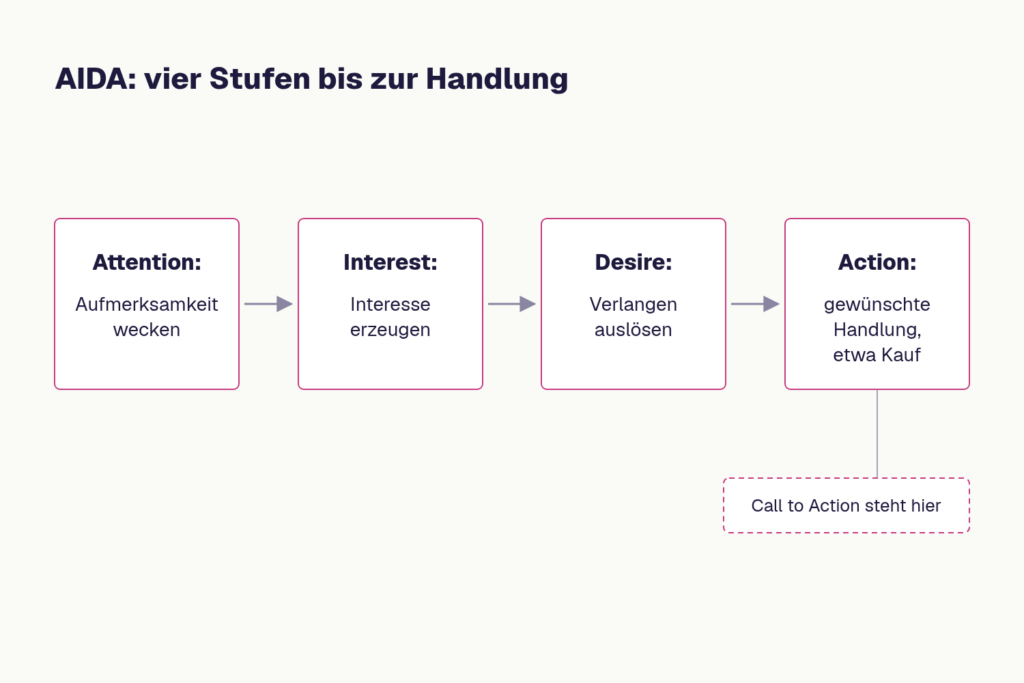
A typical example is the AIDA model. It describes four stages that a reader passes through on the way to the action:
- Attention: The text captures the reader’s attention.
- Interest: It creates interest in the offer.
- Desire: It triggers the wish to own or use the offer.
- Action: It leads to the desired action, such as a purchase.
Storytelling appears in many copywriting guides: a story begins with an initial situation, describes a path, and ends in a changed state. So far, evidence for a specific effect of storytelling in marketing texts comes only from provider sources.
The Golden Rules of Copywriting
Think of copywriting like a strong espresso: short, bold, and straight to the point.
Follow these rules when writing
- Write short sentences. One thought per sentence is enough, so cut subordinate clauses. This drastically improves readability. Nested sentences can kill conversions.
- Use active verbs. Verbs drive the action forward and create images in the reader’s mind.
- Ban the passive voice. “It is being done” sounds dull. “We do it” conveys energy.
- Cut filler words. Words like very, actually, maybe or of course weaken your message.
Passive sentences create distance and recall bureaucratic language because the actor disappears from the sentence. Nominal style, where verbs turn into nouns, has a similar effect.
A constructed example: “The processing of the order takes place via the form” becomes “Customers order directly via the form.” The second sentence is shorter, names the actor, and contains a real verb.
A finished draft can be checked systematically at these points:
- Check sentence length and split long sentences
- Flag nominalizations (nouns ending in -ung, -keit, and -tion) and turn them into verbs where possible
- Convert passive sentences into active sentences
- Replace jargon with words the target audience itself uses (“Speak the customers’ language”)
- Split complex sentences into several sentences
Persuading with psychology without violating the UWG
Many arguments in marketing texts rest on principles of persuasion described by the psychologist Robert Cialdini. The first six come from his book “Influence” (German: “Die Psychologie des Überzeugens”):
- Reciprocity: Those who receive something feel obliged to give something in return.
- Consistency/Commitment: People like to act in line with earlier decisions.
- Social Proof: The behavior of others serves as a guide.
- Liking: People tend to follow those they like.
- Authority: Expert senders appear more credible.
- Scarcity: What is available only in limited quantities seems more valuable.
- Unity: a sense of shared belonging, added in 2016 according to the provider’s own account.
Two of these principles, scarcity and social proof, directly touch on Germany’s Act Against Unfair Competition (UWG). Under § 3 Abs. 3 UWG the commercial practices listed in the annex to the Act are always prohibited in dealings with consumers.
This annex is also called the Black List. The following statements refer to German law.
Scarcity and Countdowns Only With a Real Deadline
Under No. 7 of the Black List, it is prohibited to falsely claim that a product or service is available only for a very limited time, either generally or under certain conditions, in order to induce consumers to make an immediate business decision without giving them time or opportunity to decide on the basis of information. F
For a countdown timer, this yields a test question: Does the timer reflect a real deadline, and does it claim no more than the shop actually adheres to?
For the text, this means a check before publication: Does the offer actually end at the stated time, is the stated stock actually that limited, and does the display behave the same way after the page is reloaded?
Use Reviews Only After Verification
The principle of social proof usually appears in marketing texts as a customer review or a quoted experience. Under No. 23b of the Black List, it is prohibited to claim that reviews come from consumers who actually purchased or used the product or service, without taking appropriate and proportionate measures to verify them. No. 23c prohibits transmitting or commissioning fake consumer reviews.
In addition, § 5b Abs. 3 UWG: If a trader makes consumer reviews accessible, information on whether and how it ensures that the reviews come from consumers who actually used or purchased the product or service counts as material information. For the text, this means two things: reviews may only be presented as genuine customer voices after an appropriate check, and the site must disclose whether and how this check takes place. Fake reviews are ruled out entirely as an argument.
In Practice
These sales-psychology tricks come up almost every day. Even well-trained retail staff know the possible measures, for example for social proof.
That happened to me when I was looking at office chairs in a furniture store and the salesperson called out to me in passing: “I’ve already sold 4 of this model today.”
Whether the statement is true and whether he is violating the UWG is naturally hard to judge. But it was immediately clear to me: the salesperson is relying on social proof (the behavior of others serves as a guide).
The situation is more critical with Chinese marketplaces such as Temu, AliExpress, Shein & Co. They regularly violate applicable laws. Warnings from consumer protection organizations naturally go nowhere, since the Chinese companies are difficult to pursue legally.
The problem: the apps heavily advertise extreme discounts (e.g., “up to 95% off”) or crossed-out fake prices.
In addition, these platforms rely heavily on so-called dark patterns (manipulative designs).
Anyone who opens the Temu app is flooded with countdown timers, lucky wheels, or flashing notices in the checkout process (“Hurry up! Over 126 people have this item in their cart”). These mechanisms create artificial pressure.
Headline and Call to Action
Headline and call to action are two important elements of copywriting. They decide whether a marketing text wins or loses readers.
The headline decides whether someone keeps reading.
The CTA decides whether the desired action follows.
What Makes a Good Copywriting Headline
The most common mistake we see with headlines in copywriting is that they sell features. Putting product features in the foreground, however, is fatal.
The real lever for the buyer usually lies elsewhere: what is sold is always a kind of target state. This goes one step further than translating features into benefits, as described in the section on customer language.
It is essential to put the offer’s biggest customer benefit into the headline.
In our practice, a test question serves this purpose, asked consistently from the customer’s perspective: “What’s in it for me?”
The headline must answer why a customer should look at the content, what is in it for them, and what the big promise of the offer is.
An example: we are an airline and sell flight tickets. Let’s be honest: hardly anyone enjoys flying. Stress at the airport. Security checks. Overpriced coffee. Hours spent sitting in seats that are far too small.
What we really want: to get to our destination. Anyone who wants to get to B has to travel from A to B.
The headline therefore doesn’t sell the way there, but the target state: “Your ticket to vacation.”
That conjures up very different images in our minds than the headline “Buy cheap flight tickets here.”
Formulating a Call to Action
A call to action is a prompt that directs readers’ attention to the desired action. It names this action specifically, for example “Request a quote” rather than a general prompt without a clear goal.
The CTA usually stands at the end of the text, or in the “Action” step with AIDA.
For short texts, one CTA at the end is enough. For products that need explaining and involve a lot of text, it is advisable to include the CTA button several times. That way, readers can take action at the point where they have made up their minds.
Why “Become a Member Now” Is Not Enough as an Order Button
In the order process, free wording ends. Under the so-called button solution in § 312j Abs. 3 BGB the trader must design the ordering situation so that the consumer expressly confirms with the order that they are obligated to pay.
If the order is placed via a button, it must be clearly legible and labeled with nothing other than the words “zahlungspflichtig bestellen” (order with obligation to pay) or with an equivalent, unambiguous wording.
How strictly courts interpret this obligation is shown by a ruling of the Munich I Regional Court of June 19, 2023 (File No. 4 HK O 9117/22). For a subscription that became payable after a free trial month, the label “Join now” was not sufficient (ruling text). As an example of wording that clearly expresses the payment obligation even for a subscription, the court named “subscribe for a fee (1 free trial month).
The labeling requirement under § 312j Abs. 3 BGB applies to the button through which the order is placed.
Landing Page Text Based on What Visitors Know
A marketing text written once cannot be reused unchanged in every channel, because the format and the readers’ prior knowledge determine its length and structure.
For landing pages, text length depends on visitors’ prior knowledge. Someone seeing an offer for the first time needs more explanation than someone who already knows it.
For each landing page, it is therefore worth clarifying in advance which channel visitors come from and what they already know at that point. A page for visitors from a search ad usually needs more explanation than a page that only reaches existing customers via a newsletter.
Improving the Conversion Rate with A/B Testing
The conversion rate shows whether a marketing text works. It measures the share of a page’s visitors who complete the desired action in the period observed. So if one out of 100 visitors completes the desired action, the conversion rate is 1% (1/100).
There are two test types for comparing two text versions. An A/B test measures the performance of two or more variants, such as two headlines. A multivariate test changes several elements at once, for example the design, a text section, and the CTA. Because several combinations run against each other, the traffic is split across more variants.
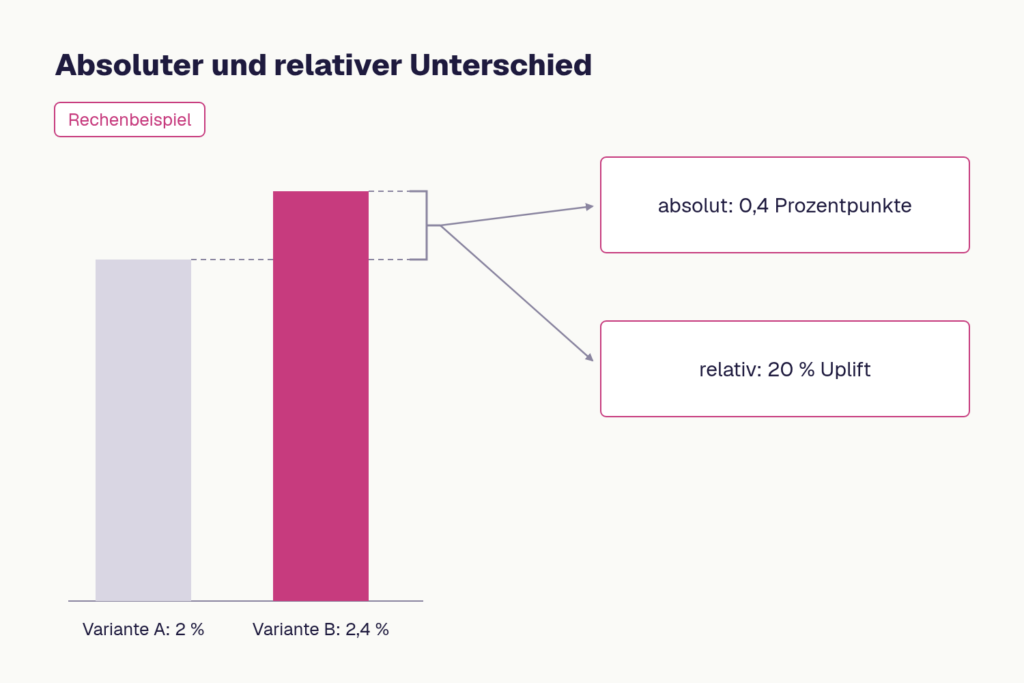
Differences between variants are usually reported as relative uplift. If the conversion rate rises from 2% to 2.4%, that corresponds to a relative uplift of 20%, even though the absolute difference is only 0.4 percentage points. To reliably separate such a small difference from chance, a test needs enough visitors.
The key term here is statistical significance. It describes the probability that a measured difference between variant A (e.g., the original) and variant B (e.g., a new landing page) actually stems from the change and not from chance.
The smaller the expected effect, the more visitors a test needs, and a higher baseline conversion rate lowers that requirement. A page with little traffic can therefore only prove large effects, such as a completely new headline, but not subtle changes like a single word. How many visitors per variant are needed for a given effect has not yet been established.
A common pitfall is stopping a test too early or judging an ad a failure too soon. The problem is recognizable in advance: the sample is too small for the expected effect. Evaluation should therefore only happen once the sample size calculated in advance has been reached.
Revising AI Drafts Instead of Adopting Them
AI text generators can serve as idea and variant generators in copywriting. For example, they help sharpen a target audience, collect possible objections, or test a text in different tones. In this way, they support gathering material and creating variants, for example for several ad headlines.
An AI draft is rarely a finished marketing text, however. Revision mainly means replacing generic wording with specific statements. Material from audience work helps here: verbatim customer phrasing and concrete objections turn an interchangeable draft into a text that speaks to a particular audience. Anyone who adopts an AI text without this revision will recognize the problem in wording that would fit any provider.
How Can You Learn Copywriting?
For the psychological foundations, “Influence” by Robert B. Cialdini is a good starting point, as the first six of the persuasion principles described above derive from it.
Books, courses, and tools speed up learning but do not replace your own writing practice. A combination of both is therefore sensible: write your own texts following the steps described, then check their effect via the conversion rate and, with sufficient traffic, via A/B tests. How long it takes to learn copywriting has not yet been established.