
AI agents handle tasks for which the solution path is not predetermined. For example, competitive research, anomaly detection in machine data, or cross-system inquiries.
The current understanding was established around 2023, when Large Language Models (LLMs) entered such systems as controlling components.
The theoretical foundation dates back to Russell & Norvig (1995)An agent is therefore an entity that perceives its environment and acts upon it.
An agent is used in business processes where a task requires multiple steps with decisions in between, and the path is not deterministic.
A common misunderstanding concerns the term Agentic AI: This is not a synonym variant of AI agent, but rather denotes the characteristic of autonomous, goal-directed action. The AI agent is the artifact, Agentic AI is the characteristic that it realizes. The LLM is also not the agent, but rather its cognitive core. This is arbitrarily interchangeable.
The term is currently used inflationarily, above all in product and marketing communication. Gartner calls the phenomenon „agent-washing“: the renaming of existing chatbots, RPA-Bots and assistants without actual agentic capabilities.
How to recognize a real AI agent
The most robust divider against agent-washing is a four-step criterion:
- A true agent plans the next step,
- runs it via a tool,
- observes the result
- and corrects course if necessary based on observation.
If one of these steps is missing, it's usually a chatbot with an API connection or a pre-wired workflow (automation).
The scale shows the vendor landscape: Gartner identified around 130 vendors positioning themselves as an agentic AI solution. However, Gartner considers most of these offerings to be relabeled assistants or chatbots without multi-step autonomy.
Those who want to be sure that it is a real AI agent can orient themselves by these three visible indicators:
- Dynamic Tool Selection The system decides at runtime which tool or data source it calls. There is no pre-configured path. If every step is visible in the Flow Editor, it is a workflow.
- Intermediate observation influences the next step: With the same input, but different intermediate results, the system performs different subsequent steps. Anyone who cannot reproduce this does not have an agent in front of them.
- Persistent memory across sessions: The agent can access previous interactions or intermediate states. A stateless single-turn bot cannot do that.
How do I build an AI agent?
An agent doesn't arise from a single tool, but from multiple layers working together:
- as the language model's cognitive core,
- a framework that controls the loop,
- an integration with the tools the agent works with,
- and a layer that records every step.
Those who distinguish these layers will find their way around the tool landscape more quickly than by using provider lists.
The first decision only concerns one of these layers, namely the framework (2.): Do you write the agent yourself in code, or do you assemble it on a visual interface (Low/No Code)? The two main paths diverge at this fork.
Coding yourself
Those who follow the code path work with an orchestration framework. Its task is to control the agent loop. It coordinates planning, tool calls, state, and resuming after an interruption.
Which framework is right depends on the project's focus.
LangGraph gilt 2026 as the most widespread choice for productive, multi-step agents because it models the process as a graph with state persistence and rollback, thus remaining reliable even if a step aborts mid-execution.
Is it more about quickly setting up a role-based prototype with multiple agents, is CrewAI the more direct way.
the agent predominantly searches in large knowledge bases, plays LlamaIndex its strength because retrieval is at the center there.
And anyone working in a Python team with strict types can rely on Pydantic AI resort to.
In addition, the major model providers offer their own SDKs. For example, the OpenAI Agents SDK, the Claude Agent SDK from Anthropic or Google ADK. These are especially worthwhile if you are already at home in one of these ecosystems.
Code solutions offer maximum flexibility, but currently also require a high level of technical skill.
No-/Low-Code
With no-code or low-code solutions, AI agents can be implemented on web interfaces with less complex programming work. Which toolkit is suitable often depends on the task itself.
If the agent is just one step in a larger process automation — for example, it's supposed to read an email, extract data from it, update a database, and finally send a notification — then n8n as the obvious choice for a Workflow Automation Platform.
N8n has built-in loops and error handling, and the agent integrates seamlessly into the rest of the workflow.
Flowise and Langflow are against open workshops specifically for LLM pipelines.
Langflow directly integrates the aforementioned LangGraph and is therefore also suitable for stateful loops.
Dify goes one step further and bundles builder, knowledge base, API layer, and logging into a single product.
For those who have to connect many different services, it is best to Make or Zapier Well served, because the connector cover is widest there.
Meanwhile, the major providers have also entered this area, such as OpenAI with the OpenAI Agent Builder.
Two layers on top
Two more layers lie perpendicular to this decision: they are added regardless of whether one has chosen code or no-code.
The first is the connection between the agent and the tool. For an agent to be able to use a tool at all, it needs a standardized connection, and that's exactly what the Model Context Protocol (MCP) provides.
Anthropic presented it in 2024 and handed it over to the Linux Foundation at the end of 2025; meanwhile, all major vendors support it, and leading frameworks have made it the standard for tool calls.
MCP handles the connection from the agent to the tool, while the related A2A protocol (Google, 2025) handles agent-to-agent connections in multi-agent systems. In practice, this primarily means one thing: Before writing your own integration, check if an existing MCP server is available for the desired tool.
The second layer, which is relevant in both cases, is observability. This means observing what the agent is actually doing. It is necessary because agents fail silently: a hallucinated answer is returned without an error message, and classic monitoring of latency and error rates notices nothing of it.
Specialized tools bridge this gap by recording every single step: every LLM call, every tool call, every planning decision.
Which of these fits depends on the environment again: LangSmith is tightly integrated with LangChain and LangGraph, Langfuse is the open-source and framework-independent variant, and Arize Phoenix offers the greatest depth in evaluation.
This layer is not an afterthought, but rather the practical answer to two problems that arise later in the post: failure modes, such as when token consumption is not measured during the testing phase, and the EU AI Act's logging requirement, which mandates that every tool call and every planning step must be traceable.
How an AI agent works
The architecture is fundamentally different from a chatbot that accepts a prompt and returns a response.
An agent runs in a loop where the LLM is not the executor, but the controller: It generates structured instructions that other components interpret — database queries, API calls, code execution. From this separation follows: Agents must be calculated differently than chat applications. The LLM is called multiple times per task, often dozens of times.
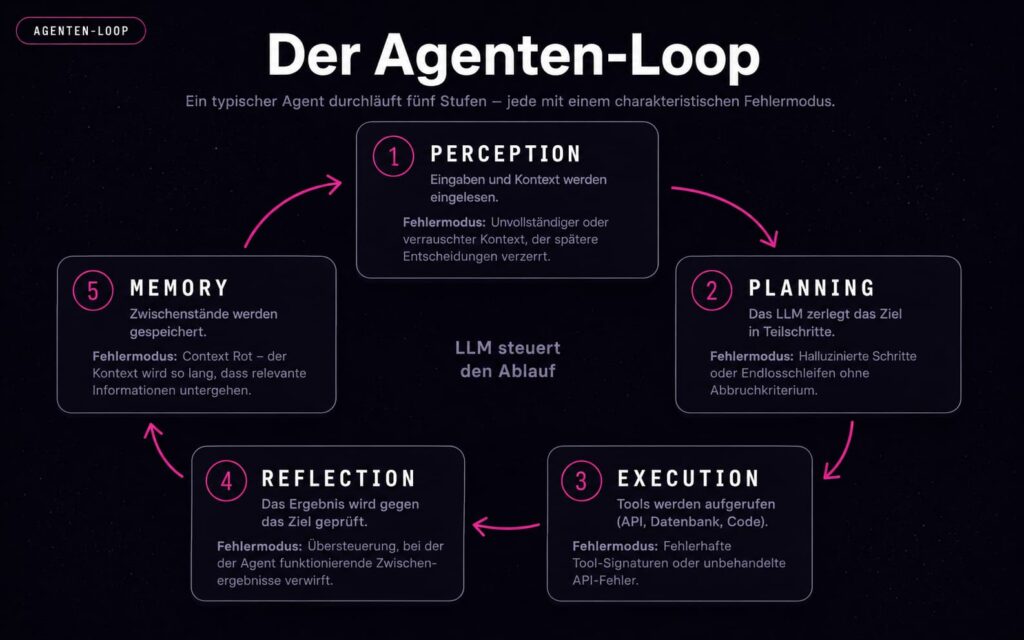
The Agent Loop
A typical agent goes through five stages, each with a characteristic failure mode:
- Perception — Inputs and context are read. Error mode: incomplete or noisy context that distorts later decisions.
- Planning — The LLM breaks down the goal into sub-steps. Failure mode: hallucinated steps or infinite loops without a termination criterion.
- Execution — Tools are being called (API, database, code). Error mode: faulty tool signatures or unhandled API errors.
- Reflection — The result will be checked against the target. Failure mode: Overwriting, where the agent discards working intermediate results.
- Memory — Intermediate results will be saved. Error mode: Context Rot — the context becomes so long that relevant information gets lost.
The ReAct Pattern
The current de facto standard for aligning thinking and acting is ReAct (Reasoning + Acting). Shunyu Yao and co-authors presented the pattern in 2022 at Princeton and Google Research.
The agent thinks one step, calls a tool, observes the result, and thinks again. It continues this process until a final state is reached.
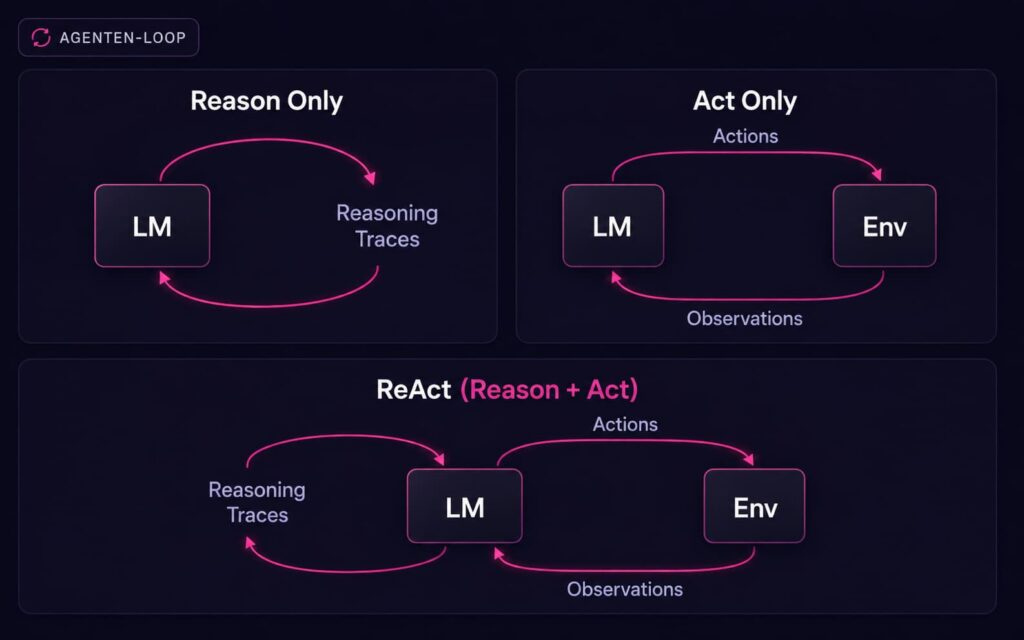
In the ALFWorld and WebShop benchmarks, ReAct outperformed previous imitation and reinforcement learning methods by an absolute 34 and 10 percentage points success rate, respectively, with only one to two in-context examples.
ReAct is worthwhile if the environment is unsafe or noisy. For tasks without tools, ReAct only adds overhead. In this case, a pure Chain-of-Thought prompt is lighter.
For deterministic workflows, where each step is known in advance, a plan-and-execute approach is more favorable. It plans once and then executes, instead of reasoning anew between each action.
Agent Types and When to Use Each
The academic taxonomy according to Russell & Norvig distinguishes four basic types, sorted by increasing generality. It is suitable as a selection matrix:
- Simple Reflex Agents react exclusively to the current input. Especially suitable when the task is stateless and the next step can be directly derived from the input.
- Model-based Reflex Agents maintain an internal state of the environment. These are necessary as soon as previous observations influence the next decision.
- Goal-based Agents Evaluate actions based on whether they bring you closer to a defined goal. These are the standard for most current LLM-based agents in business processes.
- Utility-based Agents Weighing multiple goals with different importance. Especially relevant for trade-offs, such as cost versus speed versus accuracy.
Each of these types can be extended as a learning agent that learns from results and adapts its behavior.
Next to that lies the question of single-agent or multi-agent systems (MAS).
A single agent is sufficient as long as the task can be solved as a coherent sequence. Only when it breaks down into clearly separable subtasks with their own specialized domains—such as research, analysis, reporting—does an orchestrator agent become useful, coordinating specialized worker agents. MAS costs many times more in tokens (see below).
As a heuristic, it is considered: Only split when subtasks require different domains, toolsets, or contexts—not because a single agent occasionally makes mistakes.
AI Agent or Chatbot, RPA, Workflow? What to use when
The choice of the right tool depends on the task structure, not on the available tool stack.
- RPA / Classic Workflow The path is deterministic and known in advance. Each step can be defined as a rule or a click path. Example: Transferring invoice data from PDF to SAP.
- Chatbot: One question leads to one answer. No multi-step execution, no external actions. Example: Answer FAQs about the product portal.
- AI Agent: The task requires multiple steps, the order of which depends on the intermediate result. Example: Identify ten competitors, analyze their pricing pages, create a comparison report. This is done weekly, with changing competitors.
- Assistant / Copilot: Reactive support, without autonomous multi-step execution. Humans remain in the loop and approve after each step. Gartner explicitly ranks assistants below agents.
When an AI agent is worthwhile
The deployment threshold can be determined by three criteria:
- The task has high path diversity (deterministic tasks belong in RPA).,
- it's recurring (one-off tasks don't justify development costs),
- And it has a clearly verifiable outcome (otherwise it's impossible to measure if the agent is working).
The cost scales, which are missing from many glossaries, are the second part of the "worth it" decision. Agentic systems consume 5 to 30 times more tokens per task than a single chat interaction:
- Simple Tool-Calling Agents: 5,000–15,000 Tokens per task.
- Complex Multi-Agent Systems: 200,000 to over 1,000,000 tokens per task.
- Unlimited Software Engineering Agent: According to a study by the Stevens Institute of Technology, approximately $5–8 per solved issue. This value applies to an agent without budget or step limitations; it is lower with set limits.
- Inference costs at the company level: According to ICONIQ Capital (State of AI, January 2026, Survey of approximately 300 Software Executives) for scaling stage AI companies, approximately 23 percent of revenue is attributable to inference — meaning about $230,000 in pure model costs for every $1 million in product revenue.
An architectural adjustment screw for multi-agent systems is the hierarchical distribution of model classes: frontier models only for the orchestrator, budget models for the workers.
In a benchmark for processing financial documents (SEC filings), approximately 97.7 percent of full-cost accuracy was achieved at around 60.9 percent of the cost. Whether these values can be transferred to other domains is not proven. The leverage itself (small models for routine subtasks) is considered more general.
Example Use Cases
- Predictive Maintenance An agent reads sensor data, correlates it with maintenance histories, and suggests an intervention time. According to Databricks, Lippert uses agent-assisted analytics to anticipate maintenance needs in manufacturing and logistics.
- Competitive Monitoring An agent researches defined competitors weekly, analyzes price pages, and creates a comparison report. A classic case with high path variability—different anomalies each week.
- Document Review An orchestrator agent distributes the review of a contract or report to specialized workers. One worker extracts relevant clauses, one checks against internal guidelines, and one summarizes. Here, the task breaks down into specialized subtasks. A typical candidate for a multi-agent system.
When AI agents fail in reality
Gartner predicts that by the end of 2027, over 40 percent of agentic AI projects will be abandoned, primarily due to escalating costs, unclear business value, or insufficient risk controls.
The recurring failure patterns can be recognized in advance:
- Context Rotation The agent increasingly retrieves context in long loops; relevant information gets lost in the noise. Early indicator: Rising latency and decreasing hit quality with increasing loop length during the testing phase.
- Quadratic token growth: Each new loop step processes the entire context so far. This prevents costs and latency from growing linearly. Pre-indicator: Token consumption per task not measured in test runs.
- Missing Checkpointing: If a step is interrupted, you have to start over. Preliminary indicator: The architecture diagram does not show a persistence layer for intermediate states.
- Governance Gaps Agents may perform actions without permissions, Audit-Logs and escalation paths are defined. Pre-indicator: No one can name what the agent is allowed to do and what not - and who is liable if they do it anyway.
What the EU AI Act requires for AI agents
The EU AI Act came into force on August 1, 2024, and will be applied in stages. The final major phase, originally scheduled for August 2, 2026, concerns the full enforceability of requirements for high-risk AI systems under Annex III. A political agreement in May 2026 (Digital Omnibus Package) provides for a postponement of around 16 months for Annex III systems; the formal decision was still pending as of the editorial deadline. Fines for violations can reach up to €35 million or 7 percent of the company's total worldwide annual turnover.
High-risk, as defined in Annex III, includes, among other things, AI systems in human resources (applicant selection, performance reviews), credit scoring, and critical infrastructure. An AI agent that, for example, pre-sorts incoming applications or pre-checks credit applications thus falls into the high-risk category, regardless of whether a human makes the final decision.
For such systems, specific obligations apply that must be incorporated into the agent architecture:
- Risk management system Documented identification, assessment, and mitigation of risks throughout the entire lifecycle.
- Data Governance Requirements for Training and Input Data (Relevance, Representativeness, Accuracy, Completeness).
- Technical Documentation: Complete description of design, functionality, performance metrics, limitations, and intended use — before placing on the market.
- Logging: Automatic recording of inputs, outputs, and decisions. For agents, this means: every tool call, every planning step, every reflection must be auditable.
Anyone planning an agent that could fall into a high-risk category must address logging, compliance assessment, and documentation as an architectural requirement from the outset — not as an afterthought compliance layer.
FAQ
Can a company develop AI agents itself, or does it need external help?
Prototypes can be realized internally with standard frameworks if data access and LLM infrastructure are available. Productive operation—especially multiple coordinated agents, governance, audit logging, and cost control—typically requires specialized knowledge that has not yet been built up in most companies. The high dropout rates primarily affect projects that underestimate the leap from prototype to production.
How many tokens does an AI agent consume per task?
Simple tool-calling agents are at 5,000-15,000 tokens per task, and complex multi-agent systems are at 200,000 to over 1,000,000. This is 5 to 30 times more than a single chat interaction. Token consumption per task should be measured during the testing phase, not just in production.
Is an AI agent the same as agentic AI?
No. The AI agent is the concrete software system; agentic AI refers to the underlying property of acting autonomously and purposefully. An agent is an artifact, agentic AI a conceptual attribute—providers who use both interchangeably are an indicator of muddled conceptual thinking.
When is an AI agent considered a high-risk system under the EU AI Act?
Once it is deployed in one of the application areas listed in Annex III—including personnel decisions, credit scoring, and critical infrastructure. The full enforceability of the high-risk requirements was foreseen for August 2, 2026; a political agreement in May 2026 foresees a postponement of around 16 months, with the formal decision still pending. The classification depends on the intended use, not on the technical complexity of the AI system.