
On the other end of the conversation can be a human or software, today increasingly an AI system based on large language models (LLMs).
Customers therefore do not have to find and compare products through search, filters, and navigation alone. They ask their questions in conversation and are guided through to the purchase, for example when asking about the right size. The dialogue complements the Online store search, it does not replace it.
If an AI agent makes purchases independently on the customer's behalf, it is called Agentic Commerce.
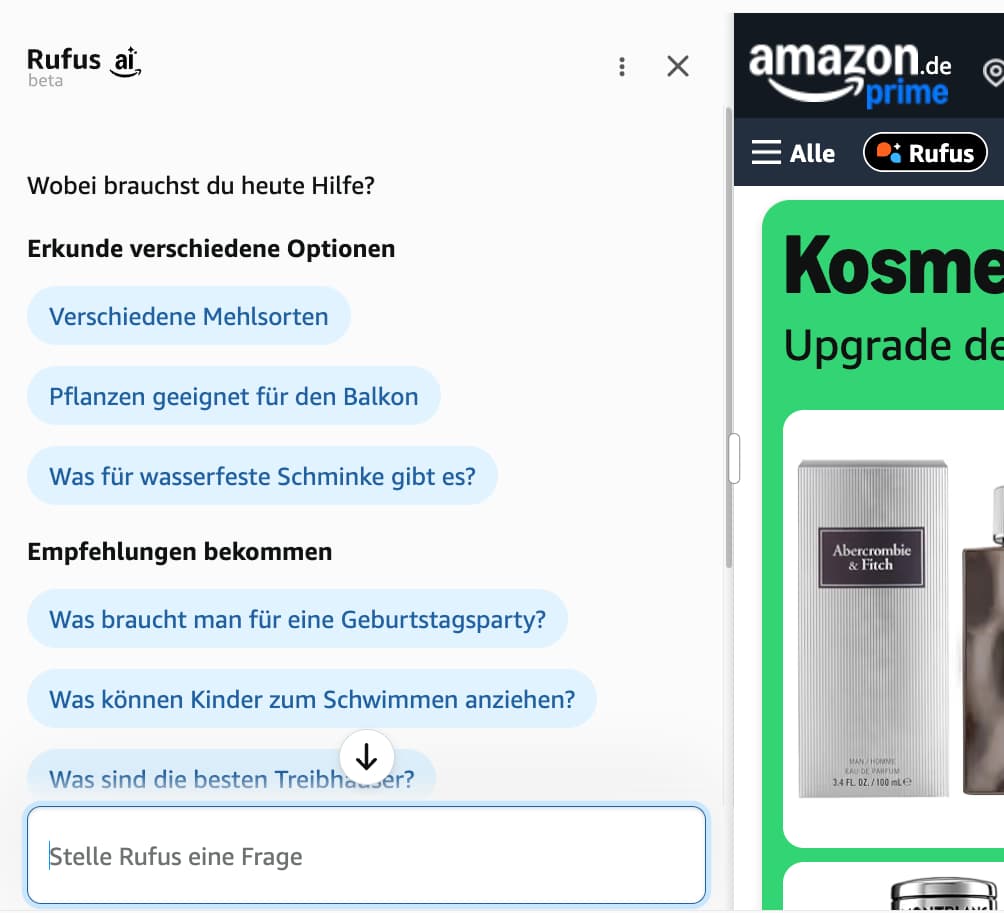
One well-known example is Amazon's Rufus. The chatbot helps shoppers find the products that suit them more quickly within the large product range.
What Conversational Commerce brings to an online shop
The benefit arises where customers would otherwise not complete a purchase or would burden the service team. Within the dialogue, three tasks can be handled:
- Advice before purchase: Which product fits, which size, is it compatible with the existing device?
- Information after purchase: for example the order status, without the customer having to write an email or make a phone call.
- Repeat purchases: reordering a product the customer already knows, directly within the conversation.
How strongly this affects conversion or average order value has not yet been established by neutral research. The widely cited figures mostly come from software vendors who describe the effect of their own products.
For an investment decision, they are at best an indication, not a planning figure. A more reliable basis is your own measurement, as described in the section on costs and success. A/B tests in your own shop can provide better benchmarks here.
An additional benefit lies in the conversations themselves. They show which questions customers actually ask before buying and where information is missing in the shop.
Systematically analyzing these conversations is called conversational analytics and is a discipline of its own. Which insights can concretely be gained from it also depends heavily on your own product range and target audience.
Where dialogue pays off and where it hardly does
Whether dialogue-based advice is worthwhile depends less on shop size than on where customers get stuck. Software providers mainly name two points as starting points for a chat:
- Product detail page: for size or compatibility questions, for example whether a replacement part fits your model.
- Before completing the purchase: for open questions about returns, shipping, or fit that could otherwise lead to abandoned purchases.
Conversational Commerce can also help with preselecting the right products, for example with questions that are difficult to map through filter functions in the shop, or with questions that a customer would typically ask a specialist salesperson in person in a store
“Which wine goes best with my planned dinner?”
“I'm looking for a guitar with airy-sounding pickups.”
“Which extraction system works best with our welding stations?”
In practice, this means that a range with many products that require explanation offers more starting points than one made up of standard items that customers buy without asking questions.
Live chat, chatbot, AI assistant, or AI agent?
Conversational Commerce does not require AI. An employee who advises customers in a chat and guides them to a purchase also counts. However, AI naturally accelerates the development enormously.
The technical variants can be described as stages. They differ in who responds, how freely phrased questions are handled, and who takes the action at the end.
| Stage | Who responds | How free-form questions are handled | Who acts |
|---|---|---|---|
| Live chat | Employees | Answered individually. | The customer buys on their own. |
| Rule-based chatbot | Software following a script or decision tree | Questions outside the script end in loops or in the contact form. | The customer buys on their own. |
| AI assistant | Software based on a language model | Answered based on product data, reviews, and policies. | The customer decides, and the purchase can be completed within the dialogue. |
| AI agent | Software with a goal and permissions | The agent pursues a goal and plans intermediate steps on its own. | The agent acts within defined permissions up to the purchase (Agentic Commerce). |
The table resolves a contradiction found in many explanations.
Some sources see completing the purchase within the conversation as the core of Conversational Commerce, while others stress that a chatbot usually does not execute purchases. Both are true: the purchase can be handled within the dialogue, as long as the customer initiates it.
If the system carries out the purchase independently, however, Agentic Commerce begins.
Conversational Commerce differs from the traditional online shop in how it is controlled. In a traditional shop, the customer navigates through categories, filters, and product pages on their own. Follow-up questions there run through separate channels such as email or phone. In dialogue, by contrast, the question, advice, and purchase come together in one conversation.
How an AI assistant answers customer questions
An AI assistant first processes the customer's input using natural language processing (NLP) and thereby recognizes what is being asked.
The decisive factor for quality is the next step: a properly built assistant searches the connected systems in a targeted way before every answer, instead of generating an answer freely from the language model. This includes the product information system (PIM) with descriptions and technical data, the shop system or the enterprise resource planning system (ERP) with prices, stock levels, and order data, as well as FAQs and policies, for example on returns or shipping.
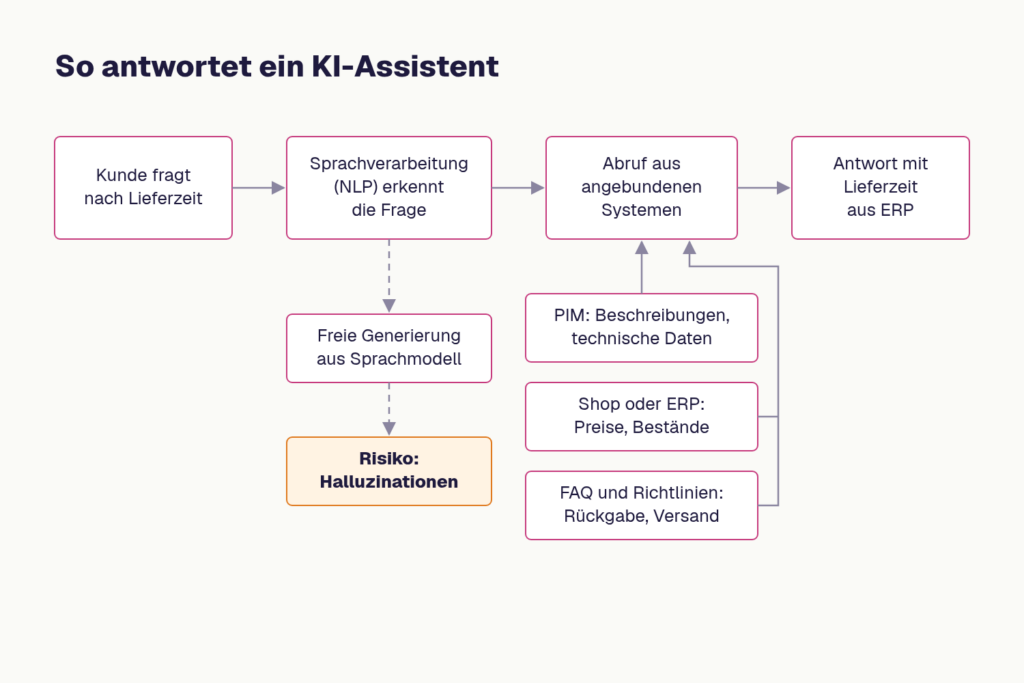
If a customer asks about the delivery time, the assistant retrieves the value from the ERP instead of deriving it from general language knowledge. When selecting or reviewing an assistant, it is therefore essential to know which sources it draws its answers from.
When a rule-based bot is sufficient
A rule-based bot matches keywords against a predefined script. This is sufficient for narrowly defined standard questions whose answer path is always the same, such as checking the order status using an order number. Its typical weakness appears as soon as customers ask in ways the script did not anticipate: questions outside the script end in loops or in the contact form. Earlier rule-based chatbots frequently frustrated customers.
For freely phrased advice questions (“Which running shoe fits a wide foot?”), an AI assistant is therefore the appropriate stage, though it should retrieve information from the shop systems rather than generate it freely. A neutral threshold for when the variety of questions makes the switch worthwhile has not yet been established. In practice, the decision can be based on your own inquiries: if routine service questions predominate, a script is enough. If individual advice questions predominate, the script reaches its limits.
Why a chatbot does not replace human staff
A representative survey on acceptance in Germany argues against full automation. In a survey published in May 2025 Bitkom survey 1,006 internet users aged 16 and older were surveyed, 978 of them online buyers.
62 percent want a human contact person who can be reached quickly when problems arise. 36 percent want a chatbot. For comparison, 52 percent named email service, 40 percent a callback, 28 percent FAQs, and 7 percent video chat. Of those who had human contact, 86 percent were satisfied.
A chatbot therefore finds considerable support, but not as the only option when something goes wrong. It can relieve the support team, but according to these figures it does not replace human contact.
For planning, this suggests a hybrid approach: the bot handles recurring questions, and a handover to employees is firmly planned for problems.
The importance of this handover becomes clear from three weak points at which a bot deployment can fail from a planning perspective:
- Unclear processes: The bot does not know what should happen after its answer.
- Poorly trained systems: The bot does not understand common questions or answers them incorrectly.
- Missing escalation paths: The customer does not reach a human when the bot cannot help.
Whether there is a proven rule for how many unsuccessful answers a conversation should take before being handed over has not yet been established. Based on the Bitkom figure, the trigger “problem” is a natural choice, for example a complaint or a failed payment. The sections on product data and the legal framework address legal risks and risks from incorrect data.
Which channels are suitable?
Conversational Commerce runs through several channels, which differ in effort and reach:
- Website- or shop chat: a chat window directly in the shop, which can start at the triggers on the product page or before completing the purchase.
- Own app: chat or assistant within the shopping app.
- Messengers such as WhatsApp: dialogue in a channel that customers already use.
- SMS: text-based communication without a messenger app.
- Social media: dialogue via the messaging functions of social networks.
- Voice assistants: purchasing by voice, referred to as a subset called voice commerce.
Software providers recommend choosing the channel according to the habits of your own customers and starting where most inquiries currently arrive. A shop whose customers mainly have questions on the product page is well served by starting with a shop chat.
Reliable usage figures by channel for Germany, Austria, and Switzerland do not yet exist. The decision is therefore best based on your own data, for example on the channels through which customers currently make contact.
WhatsApp Business App or Business Platform?
There are three variants of WhatsApp. One is ruled out from the start: the private WhatsApp app is unsuitable for business communication.
That leaves the WhatsApp Business App and the WhatsApp Business Platform (API). The legal portal e-recht24 draws a clear line between them for newsletters: to send newsletters via WhatsApp in a legally compliant way, the Business Platform must be used. Whether the Business App is sufficient beyond that for companies that answer inquiries manually, and from when the Business Platform becomes necessary, has not yet been established.
The choice affects not only functionality but also data protection and costs. The legal details are covered in the data protection section, and the fees in the cost section.
Product data as a prerequisite
A chat widget alone does not make Conversational Commerce. An assistant can only answer as accurately as the data it accesses.
Descriptions, technical data, prices, availability, and reviews must therefore be connected in real time through interfaces. Otherwise, the assistant may state a stock level or delivery time that is no longer accurate.
Before selecting a tool, you can assess your own data status with a few questions:
- Are the most important product attributes complete and clearly maintained?
- Do apps, plugins, or themes output data incompletely or in duplicate?
- Are prices and availability transmitted in real time or only with a delay?
- Are shipping, return, and payment policies maintained as text that an assistant can access?
Anyone who finds gaps in their own data should close them before launching an assistant, because every gap later reaches the customer as a wrong answer.
Data protection and liability
Three legal points must be clarified before launch: the legal basis for data processing in the chat, the privacy-compliant WhatsApp variant, and liability for incorrect information. The following points reflect the status of the sources reviewed and do not replace an individual legal review.
Which legal basis the chat requires
Anyone who processes personal data in a chat needs a legal basis under Art. 6 GDPR. Which basis applies depends on the purpose for which the data is processed.
Using WhatsApp in a GDPR-compliant way
The private app is ruled out for companies because its terms of use prohibit commercial use. According to e-recht24, data protection questions regarding the matching of contacts, communication metadata, and transfers to third countries outside the EU also apply to the business solutions. According to e-recht24, the WhatsApp Business Data Processing Terms govern data processing on behalf of the controller.
The WhatsApp Business App also has a limit. Its broadcast function reaches a maximum of 256 contacts, and according to e-recht24, newsletters sent through it do not comply with the GDPR. For newsletters, the Business Platform is recommended. Regardless of the variant, GDPR-compliant use requires, according to e-recht24, an appropriate legal basis depending on the purpose.
Liability for incorrect bot information
Whether and to what extent a merchant in Germany, Austria, or Switzerland is liable for incorrect information from its chatbot has not yet been established. However, the risk of incorrect information decreases when an assistant draws its answers from maintained policies and data instead of generating them freely. The architecture described in the section on how it works, with retrieval from PIM, ERP, and policy texts, has a preventive effect.
What does Conversational Commerce cost, and when is it worthwhile?
The costs depend on which stage, which channel, and which integration are chosen. Neutral price ranges for software are not available. The only concretely quantifiable figure is WhatsApp fees from Meta. For your own calculation, it is therefore sufficient to list all cost components completely and measure success against business figures.
What the costs consist of
The recurring and one-time costs consist of three components:
- Messaging software: license for the chat, bot, or assistant system.
- Meta fees: when using the WhatsApp Business Platform.
- Setup and integration: connection to the shop and CRM, opt-in processes for consent, design of conversation flows (flow design), and tracking.
Because Meta adjusts its rates and billing rules, the current values should be checked in Meta's official pricing overview before each calculation.
How success can be measured
A simple ROI formula can be used to assess profitability:
ROI (%) = ((Savings + Additional revenue − Total monthly costs) / Total monthly costs) × 100
The savings result from the hours saved in customer service multiplied by the hourly rate. Total costs include the license, API fees, implementation, and ongoing monitoring. A hypothetical calculation example, with freely chosen values that do not represent typical results: a shop saves 50 service hours per month at €25 each (€1,250) and attributes €750 in additional revenue to the chat, with total costs of €1,500. The ROI is then ((1,250 + 750 − 1,500) / 1,500) × 100, or about 33 percent.
The formula is only as good as the numbers that go into it. Meaningful figures include business metrics such as the rise in conversion among customers who had chat contact, revenue recovered from abandoned purchases, and the relief of support. By contrast, the number of chats handled says little, because many conversations may also indicate that information is missing from the shop. A typical mistake is therefore to measure success by chat volume rather than by revenue and service costs.
What Agentic Commerce changes for shop visibility
Agentic Commerce is the stage in which an AI agent not only advises but also carries out the purchase itself. OpenAI has introduced Instant Checkout in ChatGPT for this purpose, which is intended to enable purchases directly within the chat. It is based on OpenAI's Agentic Commerce Protocol (ACP). Whether and in which countries the feature is available to merchants has not yet been established. According to the current state, product search is primarily shifting into AI assistants.
In parallel, Google is pursuing its own approach with the Universal Commerce Protocol (UCP).
For a shop's visibility, what matters less is a separate purchasing process in ChatGPT or Google. More important is whether AI systems can find reliable data about the product range. According to a specialist article by Piazza Blu, merchants do not need to integrate every new platform immediately, but should lay the groundwork today. This includes adding missing technical attributes, resolving contradictions in prices and availability, and formulating return rules clearly rather than in hard-to-read running text. This foundation is also needed by an in-shop AI assistant, so work on product data pays off for both purposes.
FAQ
Where does the term Conversational Commerce come from?
Chris Messina coined the term in 2015. The development began with live chats in which employees answered customer questions.
Is Conversational Commerce also worthwhile for small online shops?
Neutral evidence of the benefits for small shops in particular does not yet exist. A good starting point is an existing live chat widget. It also makes sense to start at a clear trigger, such as size or compatibility questions on the product detail page, rather than running a chat on every page. Whether the effort pays off can then be checked with the ROI formula from the cost section.
How do you choose a suitable tool?
No neutral comparison of providers exists. The following questions help with selection:
- Does the tool support the channels that your customers use?
- Can it be connected to the shop, PIM, ERP, and CRM?
- Is there a planned handover to employees?
- Does an AI assistant answer based on connected data instead of generating answers freely?
- Is privacy-compliant operation possible, including consent for marketing messages?
Is Conversational Commerce the same as Conversational Marketing?
The terms are sometimes used synonymously, with Conversational Marketing then serving as another name for Conversational Commerce. A uniform distinction between the two terms has not yet been established.