While you Buyer Journey Models often maps out a theoretical, linear path (e.g., interest, consideration, purchase), in practice it often looks quite different. Before a user actually buys, they compare different options, might lose interest in between, and thus jump between the individual phases of a buyer journey before they actually buy—or perhaps don't buy at all.
Precisely this behavior is what the messy middle seeks to describe. People cycle back and forth between information search and evaluation.
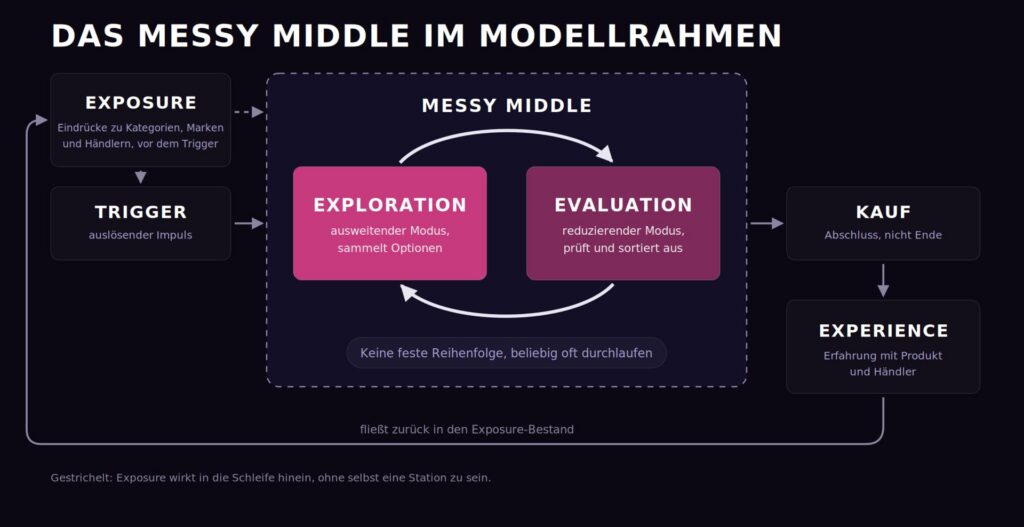
The model describes this area as two alternating mental modes: exploration widens the field of options, while evaluation narrows it down again.
Both modes are run through as often as the person deems necessary. There is therefore no linear narrowing down from many options to one.
The term originated in 2020 in a report by Google's Consumer Insights Team (Alistair Rennie and Jonny Protheroe). Also involved was the behavioral research agency The Behavioural Architects. A second part followed in 2023.
Practical explanation of the messy middle
Described in everyday terms, the messy middle is what happens between the initial thought „I actually need new headphones“ and the click on „Buy“.
People read reviews, compare models, watch videos, add something to the cart, leave the site, and start all over again two days later. This back-and-forth is not noise in the model, but the place where brands are won and lost.
How the loop between exploration and evaluation runs
Exploration and Evaluation
Exploration and evaluation are considered two central modes in the Messy Middle.
Exploration („exploration mode“) is the expanding mode: people gather options, categories, ideas, and brands that they didn't have on their radar before.
Evaluation is the reductive mode: Here, users examine, compare, and sort out.
The practical benefit of this distinction: Every activity on the net can be assigned to one of the two modes. This applies to search engines just as much as to social media, aggregators, or review sites.
A search for „home office ideas“ is part of exploration, while a search for a specific model name with the addition of „review“ is part of evaluation.
For the SEOIn practice, this means: You should think about what the user is looking for in each of the two phases, and then create content accordingly.
There is no fixed sequence of phases. Buyers switch iteratively and in loops between exploration mode and evaluation mode.
From this, a simple test for one's own category can be derived. Every page, every ad, and every video can be asked: Is it opening the user's choice window right now, or is it closing it?
Content that attempts both at the same time serves neither mode properly.
Exposure as a background before the trigger
The model framework consists of four elements surrounding the loop: Exposure, Exploration, Evaluation, and Experience.
Exposure is the background of all thoughts, feelings, and perceptions that a person already brings with them.
This refers to their impressions of categories, brands, products, and retailers even before a trigger occurs. This existing stock helps determine which brands appear in the consideration set in the first place when the initial impulse strikes.
After the purchase comes the experience, meaning the actual interaction with the product and the retailer. This experience then flows back into exposure. The model is therefore a loop and not a funnel with an exit.
For daily practice in online marketing, this means allocating resources consciously. Anyone who is only visible within the loop itself is working against an inventory of exposure that competitors have previously built up.
Messy Middle or classic funnel?
The model does not replace the classic funnel, as it does not eliminate its endpoints.
Triggers and purchase remain fixed points, exposure comes before and experience after. The messy middle merely contests the assumption in between: that the number of options steadily decreases from stage to stage.
Instead of a narrowing, he describes a back-and-forth between expanding and reducing that is gone through as often as the person needs.
What this means for marketing practice: The „classic“ buyer journey model is important in campaign planning. It gives us a good starting point.
However, in execution, monitoring, and optimization, we should always keep the messy middle model in mind.
Also: Use AIDA, Sales Funnel, and Customer Journey for planning. These models are always useful when processes need to be ordered, stages named, and key figures assigned.
The messy middle is a better fit as soon as two other questions are involved: What content needs to be present between the trigger and the purchase? And why does a person jump backward instead of moving forward?
Anyone who pits both models against each other usually loses the stepped logic without making the loop logic operationally usable.
The six biases that flip preferences
From the behavioral science literature, the creators selected six cognitive biases that are particularly effective for purchasing decisions.
Cognitive biases are systematic deviations in an evaluation process and originate from behavioral research. Google did not invent them, but selected them for the Messy Middle and tested them experimentally.
- Category heuristics („Product features“): Brief descriptions of key product specifications simplify decision-making. Anyone who names the two or three features by which a category is usually measured makes the comparison easier for the user.
- Power of now – Immediate availability: The longer the waiting time, the weaker an offer appears. Delivery time and immediate availability are therefore not purely logistical issues, but part of preference formation.
- Social proof: Recommendations and reviews from others influence the assessment, regardless of the product data itself.
- Scarcity bias: Decreasing availability increases the attractiveness of an offer.
- Authority bias: Experts and sources perceived as trustworthy shift the evaluation.
- Power of free: A free extra works even if its content has nothing to do with the product.
Important for the application: The six effects were not tested individually in the experiments, but in combination. In this context, just two of the biases are enough to shift purchasing decisions. This speaks against trying to use all six simultaneously.
What brands can concretely do in the messy middle
Different content in exploration than in evaluation
In exploration, everything that opens the consideration set contributes: category content, idea collections, and use cases. These are the contents that bring a brand into the selection in the first place.
In evaluation, the opposite contributes, namely everything that makes sorting out easier. These include:
- concise, clear descriptions of core product specifications (category heuristics)
- Customer reviews and recommendations (Social proof)
- reliable comparative information
- Information on availability and delivery time, as a long waiting time weakens the offer in the model (Power of now)
From this follows a practical sorting of one's own inventory: each page is classified according to whether it opens or closes. If either of the two groups is completely missing, the loop breaks at this point. A brand with strong category content, but without comparable specifications and reviews, is regularly weeded out during evaluation, even though it was visible during exploration.
When the loop stays short and when it drags out
The 2023 follow-up study identifies three factors that determine how confident people feel in a decision: existing product knowledge, price, and purchase permanence, meaning how long-term the commitment is. If product knowledge is present and the price and duration of commitment are low, confidence is high and the loop remains short. By contrast, unfamiliar, long-term, or high-priced purchases require more information. This tends to create barriers that delay or prevent the purchase.
As an observation tool for one's own category, search modifiers evaluated by the report over longer periods are well suited: „best“, „cheap“, „reviews“, „ideas“, and „deals“. Their shift shows how the messy middle within a category is evolving. An increasing proportion of „reviews“ and „best“ indicates a need for evaluation, while „ideas“ points to a need for exploration. The overarching finding is that search queries have become more differentiated, precise, and personal.
Securing presence without being pushy
The creators explicitly do not want to push humans out of the loop. The goal is to give them the information and confirmation they need to make their decision. This results in three starting points:
- Secure brand presence so that the brand appears in the exposure inventory and loop in the first place
- bridge the gap between trigger and purchase with relevant content
- apply behavioral science principles responsibly
The border runs where distortions no longer make a real property visible, but rather simulate a non-existent one, such as with manufactured scarcity or bought reviews.
A 2023 finding shifts priorities depending on the market role: shoppers are more likely to switch their preferred retailer than their preferred product brand, especially when price plays a role. For retailers, this means that presence and conditions during the evaluation phase can directly determine whether a customer is lost. For brand manufacturers, this means that the advantage built up through exposure is more stable. However, it can still be lost through the distribution channel.
FAQ
How long does the messy middle last?
The model specifies no duration. A range from a few minutes to days, weeks, or months is observed. During this time, people switch back and forth between comparisons, evaluations, and pauses. The 2023 follow-up study identifies three factors that drive the length: lack of product knowledge, high price, and high purchasing permanence.
Who invented the messy middle?
The term comes from Alistair Rennie and Jonny Protheroe from Google's Consumer Insights team. They created the report together with the behavioural research agency The Behavioural Architects. The initial publication „Decoding Decisions: The Messy Middle of Purchase Behaviour“ appeared in 2020, followed by the sequel „Marketing in the Messy Middle“ in March 2023. The underlying cognitive biases come from behavioural research and were selected for the report, not newly developed.
Does the model change the work of SEOs?
In prioritization yes, in the basics no. In addition to the funnel stage, content can be sorted by whether it expands or reduces the option field. Search modifiers such as „best“, „reviews“ or „deals“ also indicate the mode in which a category is currently being searched. Technical requirements and content quality criteria remain unaffected by this.
Is AI-powered product search changing the messy middle?
The model structure consisting of exposure, trigger, exploration, evaluation, purchase, and experience remains unchanged for now, because it describes behavior rather than channels. So far, the only verifiable trend from the search modifier analysis is that search queries are becoming more differentiated, precise, and personal. Everything else regarding the impact of generative systems on the loop is not substantiated in the available material and remains open.
Is the Messy Middle the same as the book of the same name by Scott Belsky?
No. Belsky's „The Messy Middle“ (2018) describes the volatile middle phase of new ventures and creative projects between the „first mile“ and the „final mile.“ It deals with the progression of foundings and projects, not purchasing decisions. Other than the identical name, there is no content-related connection to the Google model.