It connects the craft of search engine optimization with compelling writing for people (copywriting), so that they are ultimately ready to act.
Most often, the term is used as a synonym for „writing SEO text.“ So Keyword research, Such an intention meet, structure with H-levels, cover entities, internal linking. Strictly speaking, that is SEO content writing, not copywriting.
Since the early 20th century, copywriting has referred to the writing of Werbeanzeigen, ..., and it was always about selling. Many agencies still call it copywriting because it sounds more sophisticated than „text creation.“.
For clarification:
- SEO content writing concerns visibility pages: guides, glossaries, blogs. The goal is ranking and trust; conversion happens indirectly via internal links.
- SEO copywriting pertains to money pages: category, product, service pages, and landing pages.
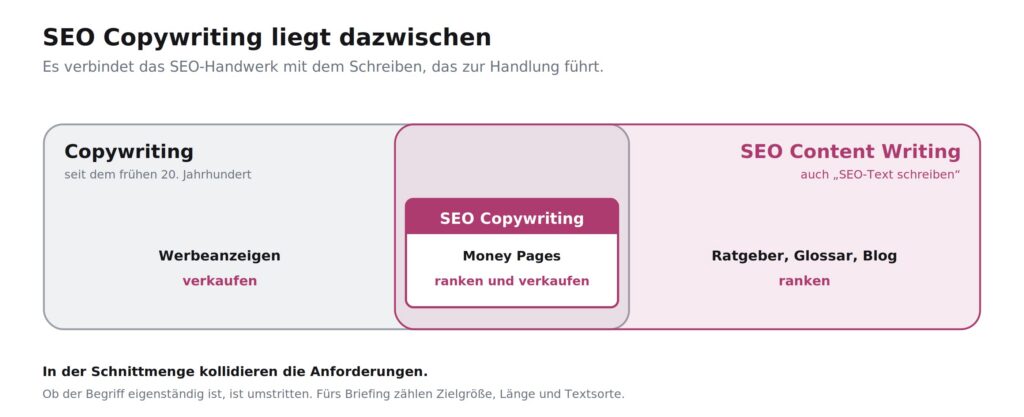
SEO copywriting needs to do two things simultaneously: rank and sell.
And that's precisely where the disciplines collide. The copywriter wants the benefit arguments and the call to action at the top, while SEO wants keyword coverage and text volume. Whoever resolves this conflict achieves true SEO copywriting.
Part of the industry considers.
In practice, this means: The copywriter first clarifies what search intent lies behind a keyword. They then use keywords and structure in such a way that Google recognizes the topic, and they incorporate elements like calls-to-action or social proof.
First, clarify the search intent
Before the first line is the question of what a searcher expects from this keyword. Google distinguishes between four basic types:
- seeking information
- transactional (perform an action)
- navigational (finding a specific page)
- commercial (compare options)
The type dictates what format and depth are expected. SISTRIX counts this as one of the most common beginner mistakes. Content that doesn't match the actual user intent will miss its target even if it's technically correct.
An example from an agency blog shows how strong this effect is. For the keyword „bedroom decor ideas,“ even a keyword-rich flowing text doesn't rank because the search intent clearly targets images. Therefore, a text can miss the intent and remain unread, even if it is cleanly optimized.
The resulting work step is verifiable: For each topic, determine whether information, navigation, or transaction is the primary focus, and adapt the format and depth accordingly. A look at the current top results for the keyword shows which format Google has already confirmed for this query, such as a guide, category page, comparison, video, or image gallery.
From keyword to finished text
Once the intention is clarified, the next step is to focus on the content structure.
Google needs to understand the content, and people should be able to read, link, and share it. If you only write for Google, the text sounds robotic; if you only write for readers, important keywords are missing. This balance is the core of the work.
There are several building blocks that come together for this:
- The keyword is in headings and in the text, but without keyword stuffing.
- The content serves the search intent, rather than just touching on the topic.
- Persuasive elements such as calls-to-action and social proof lead to the desired response.
- The structure remains readable, meaning subheadings, paragraphs, and a discernible outline.
For the sequence, this results in a practice: make the keyword and topic visible early on, meaning in the title, H1, introduction, and at least one subheading.
The persuasive elements come in where the reader's question is answered. A call-to-action before the answer meets a reader who has no reason to act yet.
How often does the keyword need to appear?
The rule of thumb „1 to 3 percent keyword density“ continues to circulate in guides, often along with the advice to use two to three primary keywords per page. It's not reliable, as there is no primary source or Google statement that names a target range.
From our perspective, perfect keyword density is an SEO myth. Historically, the rule originated from a time when „writing SEO text“ primarily meant fulfilling a requirement like „500 words with 2.5 percent keyword density.“ Five occurrences in 100 words results in a 5 percent density.
The robust benchmark is in Google's spam policies. Keyword stuffing is defined there as filling a page with keywords or numbers to manipulate rankings.
The practical question, therefore, is not „what percentage,“ but „does a passage sound unnaturally repetitive when read aloud.“.
WDF*IDF is the methodologically sounder successor to keyword density, but also not an (official) ranking factor. WDF stands for „within document frequency“ and measures how often a term appears in a document, IDF for „inverse document frequency.“.
The benefit lies elsewhere than in the number: The analysis shows which terms competitors use alongside the main keyword. This helps to find proof keywords and missing thematic aspects. As a tool for topic research, it is therefore useful, but not as a target. It is only one of many text optimization methods and not a key to a top 10 ranking.
How long does an SEO text need to be?
John Mueller from Google answered the question concisely on Reddit: „Word count is not a ranking factor. Save yourself the trouble.“ He added that word count is not an indicator of quality. Some pages have many words that say nothing, while others have very few words that are very important and relevant to a search query.
The often-cited counter-argument comes from a Backlinko analysis of 11.8 million search results: the top 10 contain an average of 1,447 words. That's a correlation, not causation.
Longer texts don't rank because of their length, but because complete answers rank, and completeness requires space for many topics. The fact that tools still output fixed numbers explains the myth: three optimization tools give three different „optimal“ lengths; Yoast, for example, suggests a minimum length of 300 words.
Instead, the keyword-related comparison that Malte Landwehr described in the same thread is useful. If the average word count for the top 20 results for „how to file my taxes“ is 2,000 and for „how many calories in a cheeseburger“ is 200, then this shows whether long-form content or a quick answer is desired. The length therefore stems from the specific keyword and its top-ranking results, not from a general target.
How Google recognizes quality
Google describes the standard as „people-first content“ or. user-oriented content.
Also, content that is created for people first, not to manipulate rankings. Google explicitly recommends focusing on this instead of „search engine-first content.“ This includes concrete self-assessment questions that can be applied as a checklist to a finished text:
- Is there an existing or intended audience that would find the content useful?
- Does the content show first-hand experience and depth of content, such as expertise from actually using a product or visiting a place?
- After reading, did anyone learn enough to achieve their goal?
- Was the experience satisfactory?
In addition, there's E-E-A-T. Google's systems recognize factors that indicate Experience, Expertise, Authoritativeness, and Trustworthiness. Of these aspects, Trust is the most important. For text creation, this means: Verifiable origins of statements and recognizable personal experience contribute more than additional paragraphs on the same point.
Google's position on AI is clearly stated. Regardless of how content is produced, those seeking success should create original, high-quality, people-first content with E-E-A-T qualities. The method of production is therefore not the criterion; the result is. Google draws the line elsewhere: „scaled content abuse“ is on the list of violations alongside keyword stuffing. So, those who use AI to accelerate research and raw text, and then add experience, review, and structure, remain within the guidelines. Those who produce large amounts of text with it without their own contribution, cross the line.
SEO copywriting or SEO text?
The SEO scene itself debates whether SEO copywriting is even a distinct term. There are essentially three positions.
- Position 1 sees the difference in text type, length, and goal: SEO copywriting aims for lead conversion rather than organic traffic and is shorter. Where a blog post might have almost a thousand words, copywriting often gets by with less than half.
- Position 2, on the other hand, maintains that opinions differ and interprets the difference as a level of quality, not a text type.
- Position 3 denies a meaningful difference and calls SEO copywriting „more precisely SEO content writing.“.
This has a clear consequence for briefings. Because the term is not clearly defined, it alone does not constitute a work instruction. Instead of arguing about the term, it's better to state the goal in the briefing: target metric (conversion or organic traffic), expected length, and text type.
Those who order „SEO Copywriting“ and expect a 1,500-word guide may, depending on your perspective, receive a short landing page.
FAQ
Are copywriting and SEO copywriting the same thing?
Not quite, and sources disagree. Both come from copywriting, but differ in their goal: HubSpot assigns SEO copywriting to lead conversion and classic SEO content writing, such as blogging, to organic traffic. Other sources see the difference only in the quality level or deny it altogether. For practical purposes, the target metric in the briefing is more important than the designation.
Is SEO copywriting enough to rank on Google?
No. The text is a building block alongside technical findability and domain authority. Without a matching search intent, it won't have any effect at all. This is shown by the example „Bedroom decor ideas,“ where Google expects images, and a flowing text, even if rich in keywords, won't rank.
What does an SEO text cost?
Classic answer: It depends. How complex is the topic? How much expertise is required? Even with AI support, a good SEO text for a simple topic requires at least one hour of work, more likely two. Complex topics, however, can easily take up to 16 hours. An SEO copywriter typically earns between 50 and 140 Euros gross per hour. The exact hourly rate depends heavily on experience and expertise.
May I use AI texts for SEO?
Yes, the production method is not the criterion for Google. What matters is that the result is original and human-made, and demonstrates E-E-A-T qualities. The line is drawn at „scaled content abuse,“ meaning mass production on a large scale, which Google considers a violation.
Does SEO copywriting still work with AI Overviews?
Google says: „Good SEO is good GEO“The proven constants remain the same: meeting search intent, writing people-first, and demonstrating experience and trust.
How to become an SEO copywriter?
In addition to classic copywriting, SEO must also be mastered. Equally important skills are UX writing, brand voice, and Conversion optimization. Classic skills such as keyword and intent analysis, as well as persuasive writing with structure and a call to action, are required.